I think white pines are beautiful trees, especially at maturity, and they have the added advantage that they are one of the few conifers that don’t try to kill you with their needles. Besides working with the foliage, have you ever had to “rescue” a child who climbed too high in a spike-infested deathtrap of…Read more about Declining Pines of the White Variety[Read More]
Resources for landscapes and gardens in the Midwest
Landscape Report
Found 534 Articles
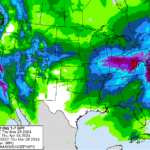
The 2023-2024 meteorological winter (December, January, and February) has concluded, but it seems as if we only experienced a couple weeks of winter-like weather this season. Indiana’s average temperature was 35.8°F, which was 5.3°F above normal. This was good for Indiana’s second warmest winter since records began in 1895. The warmest winter on record was…Read more about The Winter that Wasn’t[Read More]

Hoosiers are in for a special treat this spring. If you have lived in Indiana for more than a year, you have probably grown accustomed to the singing of cicadas in the later days of summer. However, in some years, cicadas will emerge in the spring. This occurred in 2021 when most of the state…Read more about Cicadas in Spring![Read More]

Welcome to the 2024 Purdue Landscape Report! We’ll be sending out the newsletter every other week throughout the growing season. New in 2024 we’ll be featuring bi-weekly articles from the Indiana State Climate Office. As we all know, the ‘new normal’ for weather is now ‘abnormal’. The State Climate Office will be providing a recap…Read more about Welcome to the 2024 Purdue Landscape Report[Read More]

Inonotus dryadeus is one of the more common wood decay fungi we receive at the diagnostic lab in association with declining trees, specifically oaks. Inonotus is found so frequently on oaks it has the common name oak bracket fungus, but it can cause root rot of a number of other hardwood trees (including maples, sweet…Read more about Inonotus Dryadeus – butt and root rot of oaks[Read More]

Temperatures are finally dropping and leaves are changing color. Autumn is progressing well in my opinion. Before you know it winter will be here, and some people will be wondering is there anything to be done to better protect the trees around you? The answer is yes, and I applaud you for your initiative to…Read more about Autumn Tree Care: “What Can I Do?”[Read More]

The Women of the Green Industry will be offering two, free educational opportunities on November 7th and December 5th on Zoom: https://purdue-edu.zoom.us/j/95932197520?pwd=KysxUHFPSzZiOTlwcmFZU3hUSXFpZz09 November 7th will feature Karen Mitchell, Purdue Consumer Horticulture Specialist, to present ‘The Social Side of Seeds: Growing Your Community’ December 5th will feature Pedra Sage, owner of Sage Garden Designs, who…Read more about Join Women of the Green Industry on November 7th and December 5th[Read More]

Asian bush honeysuckle (Lonicera spp.) is an extremely invasive plant that is a serious problem in most areas of the Midwest. These invasive plants grow very fast, especially along woodland edges, and shade out most of the understory plants that are found in these areas. Honeysuckle can also significantly reduce the available browse for deer…Read more about Consider Fall Eradication of Asian Bush Honeysuckle[Read More]

Mites are eight-legged arthropods who pierce plant cells to feed on them. Plants that are attacked by mites lose their green color and appear somewhat bronzed. Spider mites will make webs to help them forage on leaves unencumbered by irregular leaf surfaces. The accumulation of webs, and old skins of mites can give heavily infested…Read more about Tune up Your Spider Mite Management This Fall[Read More]

Dead man’s fingers is an apt moniker for a gruesome-looking fungus (Xylaria polymorpha and related species) that produces club-shaped fungal fruiting bodies that appear as fingers growing around the base of dying or dead woody plants and even wooden objects in soil (Fig. 1). With more than 25 species of Xylaria, generalizations are difficult to…Read more about Dead Man’s Fingers[Read More]

Later this week, fall finally brings the respite of cooler temperatures and a much-needed drink of rainfall. While the cool-season species such as tall fescue and Kentucky bluegrass that dominate most of the Indiana lawnscape revel in this well deserved breather from disease pressure and high temperature stress, the metabolism of warm season plant species…Read more about Fall Brings Football & A Lawn Policy Shift[Read More]

The 2023 Purdue Turf and Landscape Seminar will be held on November 16th and 17th at the W.H. Daniel Turfgrass Research and Diagnostic Center in West Lafayette, IN. This event is designed for intermediate and advanced turf and landscape professionals, providing them with the latest technology for managing turf and landscape systems, and to maintain…Read more about Purdue Turf and Landscape Seminar Announced[Read More]

Planting may not be the first chore that comes to mind when considering the fall garden, but as Purdue Urban Forestry Specialist, Ben McCallister mentioned in the last issue, it’s an excellent time to install a new tree1. However, trees aren’t the only thing that can be added to the garden this time of year. …Read more about The Perennial Garden: Fall Planting and Propagation[Read More]

Many areas around the Midwest continue to creep towards an increasing drought situation (Fig. 1). Currently almost 80% of the Midwest is listed as being abnormally dry to exceptional drought (Fig. 2). Current soil moisture data indicates that most of the Midwest is very dry (Fig. 3). Going into the fall it’s very important…Read more about Drought Spreading Throughout Much of the Midwest[Read More]

A new invasive insect of concern has been identified in the state of Georgia. In August of 2023, Georgia’s Department of Agriculture, along with the USDA, confirmed the presence of the yellow-legged hornet, Vespa velutina, outside of the city of Savannah. To date, this is the only confirmed identification of this insect in the United…Read more about New Invasive Predator of Honeybees[Read More]

Many trees are planted for their beautiful fall color, especially in locations where the climate provides reliable autumn weather. I have said this multiple times during extension talks and conversations with submitters to the PPDL, but I seem to have not experienced a ‘normal’ fall since moving to Indiana with how erratic the weather has…Read more about Early Fall Color – A Symptom of Stress[Read More]

When I was a kid, if you’d asked me what my favorite season was it would always immediately be summer. No school, time for playing outdoors, swimming, hiking, and late nights playing flashlight tag. Now, if I ranked the seasons from worst to best, they’d be Summer in last, followed by Winter (yes, I choose…Read more about Can I Plant Trees in the Fall?[Read More]

Wet summer weather always brings in a surplus of plant diseases, but few are as dramatic as clematis blight, caused by the fungus now called Calophoma clematidina (formerly Ascochyta or Phoma clematidina) (Fig. 1). The rest of us simply call it clematis blight or clematis wilt. Why the confusion with both the common and Latin…Read more about Blasted Clematis Blight[Read More]
Help IR4 Help You! The IR-4 Project provides the research necessary for pesticide registration on ornamental plants. IR4 operates as a unique partnership between the U.S. Department of Agriculture (USDA) – both the National Institute of Food and Agriculture (NIFA), the Cooperative State Research Education and Extension Service (CSREES), the Agricultural Research Service (ARS),…Read more about Help IR4 Help You![Read More]

Stop me if you’ve heard this one…. A tree is in a slow decline year after year. You are called to your client’s property only to find the root flare well below grade. Most professionals in the Green Industry have encountered this at some point in their career. The most common reason for the slow…Read more about Another Case of Mortality from Planting Trees Too Deep[Read More]
It is the policy of the Purdue University that all persons have equal opportunity and access to its educational programs, services, activities, and facilities without regard to race, religion, color, sex, age, national origin or ancestry, marital status, parental status, sexual orientation, disability or status as a veteran. Purdue is an Affirmative Action Institution. This material may be available in alternative formats. 1-888-EXT-INFO Disclaimer: Reference to products in this publication is not intended to be an endorsement to the exclusion of others which may have similar uses. Any person using products listed in this publication assumes full responsibility for their use in accordance with current directions of the manufacturer.
Sign-up to receive email news and alerts from Purdue Landscape Working Group:

This is US

For More Information

Purdue Home Page

Purdue Extension

Find your county office