Most people these days have, at the very least, heard of Callery and Bradford pear trees and know something about the invasiveness of this ornamental street tree. But I still get questions about what it is and why it’s so bad. So, I’d like to offer a little history of this infamous tree. Where did…Read more about Invasive Bradford/Callery Pear: Why it is so detrimental and what to plant instead.[Read More]
Resources for landscapes and gardens in the Midwest
Landscape Report
Found 585 Articles

Rocky Mountain juniper, Juniperus scopulorum, has gained some popularity in Midwest landscapes due to cold and drought tolerance, and to the availability of several upright columnar varieties with attractive blue color, including ‘Skyrocket’ and ‘Wichita Blue’. Like many other junipers, J. scopulorum may suffer dieback of small branches and twigs caused by the fungal pathogens…Read more about A Triple Threat to Rocky Mountain Juniper: Cytospora, Diplodia and Botryosphaeria[Read More]

It’s gonna be… I mean… it’s already May! How can this be? Early spring flowers have already cycled through, I’m on record pace for mowing my yard, and field activity has been delayed due to a wet April. April began a bit cool with several mornings having frost advisories and freeze warnings, which was not…Read more about April Ends Warm and Wet[Read More]

Identifying a plant problem is the first step to improve the health of plants in the landscape. We created a series of short (5 to 7 min) YouTube videos to help you learn or just brush up your plant diagnostic skills. Each video guides you through the diagnostic process in real landscapes, reviews pest biology…Read more about Learn to Diagnose Plant Problems with Quick Guide YouTube Videos[Read More]

Identificar qué problema tiene la planta es el primer paso para mejorar la salud de las plantas en el jardín. Hemos creado una serie de videos cortos (5 a 7 minutos de duración) en YouTube. Esto lo hemos hecho para ayudarlo a aprender o simplemente mejorar sus habilidades de diagnóstico de plantas. Cada video te…Read more about Aprenda a Diagnosticar Problemas de las Plantas con Videos en YouTube[Read More]

Gardeners are bombarded with sayings like save the stems, leave the leaves, and no mow May. These sayings are rooted in the same goal of protecting pollinators, but often leave gardeners with more questions. Let’s dig into each of the sayings. Save the stems: The first question that often arises from this saying is: “When…Read more about So, the saying goes… Save the Stems, Leave the Leaves, and No Mow May[Read More]

Hydrangea L. (family Hydrangeaceae Dumort) is an all-encompassing description of a group of herbaceous and woody flowering plants, composed of more than 80 species native to Asia (including Japan), Indonesia, the Americas. Popular hydrangea species include the bigleaf hydrangea (Hydrangea macrophylla), also known as French hydrangea, panicled (peegee) hydrangea (H. paniculata), oak-leaf hydrangea (H. quercifolia) and mountain hydrangea (H. serrata). Hydrangea…Read more about Viruses of Hydrangea[Read More]

There was an interesting conversation among drought experts this week about how best to communicate drought, particularly when surface conditions appear so saturated. I thought of Indiana a lot during this discussion because with all the rain the state has received over the last several weeks (over twice the normal amount!), there is localized flooding,…Read more about Wet conditions continue[Read More]

An old saying predicts that March will go out “like a lamb”. Another saying predicts April’s wetness with “April showers bring May flowers”. A lot seems to have happened across Indiana since April began, but March finished the month with below-normal rainfall (except for the northern counties) and above-normal temperatures. Does this describe conditions that…Read more about As the sayings go… (Climate & Weather)[Read More]

Blight, Leafminers, and Moths: The Plight of Boxwoods Boxwoods (Buxus spp.) were introduced into the United States during colonial times, and still today they are one of the most popular evergreen shrubs used in landscapes. They are frequently selected for hedges and topiaries because they are easily trimmed into geometric shapes. They were also easy…Read more about Blight, Leafminers, and Moths: The Plight of Boxwoods[Read More]

Vascular streak dieback is an emerging issue on woody ornamentals in the nursery industry. We have provided information on this topic as the situation has been unfolding (https://purduelandscapereport.org//article/vascular-streak-dieback-of-redbud-what-plant-pathologists-know-so-far/; https://indianagreenexpo.com/sessions/vascular-streak-dieback-an-emerging-issue-in-nursery-stock/). Researchers and Collaborators working on vascular streak dieback will be presenting up-to-date information during the tHRIve webinar hosted by Horticultural Research Institute on Thursday, April 11,…Read more about Webinar on Vascular Streak Dieback[Read More]

I think white pines are beautiful trees, especially at maturity, and they have the added advantage that they are one of the few conifers that don’t try to kill you with their needles. Besides working with the foliage, have you ever had to “rescue” a child who climbed too high in a spike-infested deathtrap of…Read more about Declining Pines of the White Variety[Read More]
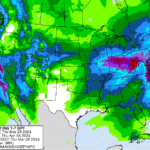
The 2023-2024 meteorological winter (December, January, and February) has concluded, but it seems as if we only experienced a couple weeks of winter-like weather this season. Indiana’s average temperature was 35.8°F, which was 5.3°F above normal. This was good for Indiana’s second warmest winter since records began in 1895. The warmest winter on record was…Read more about The Winter that Wasn’t[Read More]

Hoosiers are in for a special treat this spring. If you have lived in Indiana for more than a year, you have probably grown accustomed to the singing of cicadas in the later days of summer. However, in some years, cicadas will emerge in the spring. This occurred in 2021 when most of the state…Read more about Cicadas in Spring![Read More]

Welcome to the 2024 Purdue Landscape Report! We’ll be sending out the newsletter every other week throughout the growing season. New in 2024 we’ll be featuring bi-weekly articles from the Indiana State Climate Office. As we all know, the ‘new normal’ for weather is now ‘abnormal’. The State Climate Office will be providing a recap…Read more about Welcome to the 2024 Purdue Landscape Report[Read More]

Inonotus dryadeus is one of the more common wood decay fungi we receive at the diagnostic lab in association with declining trees, specifically oaks. Inonotus is found so frequently on oaks it has the common name oak bracket fungus, but it can cause root rot of a number of other hardwood trees (including maples, sweet…Read more about Inonotus Dryadeus – butt and root rot of oaks[Read More]

Temperatures are finally dropping and leaves are changing color. Autumn is progressing well in my opinion. Before you know it winter will be here, and some people will be wondering is there anything to be done to better protect the trees around you? The answer is yes, and I applaud you for your initiative to…Read more about Autumn Tree Care: “What Can I Do?”[Read More]

The Women of the Green Industry will be offering two, free educational opportunities on November 7th and December 5th on Zoom: https://purdue-edu.zoom.us/j/95932197520?pwd=KysxUHFPSzZiOTlwcmFZU3hUSXFpZz09 November 7th will feature Karen Mitchell, Purdue Consumer Horticulture Specialist, to present ‘The Social Side of Seeds: Growing Your Community’ December 5th will feature Pedra Sage, owner of Sage Garden Designs, who…Read more about Join Women of the Green Industry on November 7th and December 5th[Read More]

Asian bush honeysuckle (Lonicera spp.) is an extremely invasive plant that is a serious problem in most areas of the Midwest. These invasive plants grow very fast, especially along woodland edges, and shade out most of the understory plants that are found in these areas. Honeysuckle can also significantly reduce the available browse for deer…Read more about Consider Fall Eradication of Asian Bush Honeysuckle[Read More]

Mites are eight-legged arthropods who pierce plant cells to feed on them. Plants that are attacked by mites lose their green color and appear somewhat bronzed. Spider mites will make webs to help them forage on leaves unencumbered by irregular leaf surfaces. The accumulation of webs, and old skins of mites can give heavily infested…Read more about Tune up Your Spider Mite Management This Fall[Read More]
It is the policy of the Purdue University that all persons have equal opportunity and access to its educational programs, services, activities, and facilities without regard to race, religion, color, sex, age, national origin or ancestry, marital status, parental status, sexual orientation, disability or status as a veteran. Purdue is an Affirmative Action Institution. This material may be available in alternative formats. 1-888-EXT-INFO Disclaimer: Reference to products in this publication is not intended to be an endorsement to the exclusion of others which may have similar uses. Any person using products listed in this publication assumes full responsibility for their use in accordance with current directions of the manufacturer.
Sign-up to receive email news and alerts from Purdue Landscape Working Group:

This is US

For More Information

Purdue Home Page

Purdue Extension

Find your county office