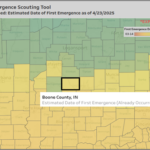
Midwestern farmers have faced a buildup of pesticide resistance in pigweeds (waterhemp and Palmer amaranth), highlighting the importance of scouting to detect weeds early in their growth stages. Otherwise, weed escapes are a common issue as herbicides lose their efficacy when weeds are allowed to grow long enough into their growth cycle. The Midwestern Regional…Read more about Midwestern Regional Climate Center Launches New Experimental Weed Emergence Scouting Tool[Read More]
Resources for landscapes and gardens in the Midwest
Landscape Report
Weeds
Some of you may recall news in 2020 about unsolicited seeds being sent in the mail from overseas (https://www.purdue.edu/newsroom/archive/releases/2020/Q3/unsolicited-seeds-could-wreak-havoc-on-agriculture,-environment,-state-officials-warn.html). There have now been recent reports of this happening again. Ric Bessin, Entomology Extension Specialist, and Joe Collins, Deputy State Entomologist, from the University of Kentucky, wrote about reports of unsolicited seeds from the south,…Read more about More Reports of People Receiving Unsolicited Seeds[Read More]
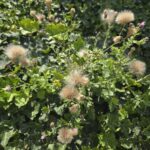
As summer comes to a close, plants are rapidly releasing seeds and the most noticeable are the flying fluffy type. Thistles, asters, and milkweed are just a few of the summer-flowering plants that depend on the wind to disperse their seeds, sometimes carrying them miles away to potentially suitable locations, though seeds typically land with…Read more about What the Fluff?![Read More]
A recent conversation with a landscaper about tank mixing led to a brief discussion about glyphosate products with a contact herbicide included. I thought I would share my thoughts on the addition of contact herbicides and its effectiveness on weed control. We all know that we live in a microwave society. Most people want things…Read more about Does weed control improve with adding a contact herbicide to glyphosate?[Read More]

Asian bush honeysuckle (Lonicera spp.) is an extremely invasive plant that is a serious problem in most areas of the Midwest. These invasive plants grow very fast, especially along woodland edges, and shade out most of the understory plants that are found in these areas. Honeysuckle can also significantly reduce the available browse for deer…Read more about Consider Fall Eradication of Asian Bush Honeysuckle[Read More]

The 2023 Purdue Turf and Landscape Seminar will be held on November 16th and 17th at the W.H. Daniel Turfgrass Research and Diagnostic Center in West Lafayette, IN. This event is designed for intermediate and advanced turf and landscape professionals, providing them with the latest technology for managing turf and landscape systems, and to maintain…Read more about Purdue Turf and Landscape Seminar Announced[Read More]

Poison hemlock was introduced to North America as a garden/ornamental plant. It is a native of Europe, and it is a member of the Apiaceae (parsley) family. Purdue experts Bill Johnson and Marcelo Zimmer wrote about poison hemlock in a Purdue Pest & Crop newsletter. They wrote that poison hemlock can be noticed very early…Read more about Recognizing and Managing Poison Hemlock[Read More]

Garlic mustard (Alliara petiolata) can be found in public parks, backyards, meadows, forests, gardens, and along roadsides throughout Indiana. The leaves have a strong garlic smell to them. Garlic mustard was first introduced from Northeastern Europe in the 1860s in Long Island, New York. Immigrants from Europe used it for food (an herb), medicine, and…Read more about Managing Garlic Mustard[Read More]

Join us at the Purdue Turf and Landscape Field Day on July 26th! The Purdue Turf and Landscape Field Day is an annual one-day event with the objective of providing professional turf and landscape managers exposure and educational opportunities with the latest research and technical resources. The Field Day features research tours, talks on current…Read more about Purdue Turf and Landscape Field Day[Read More]

Over the past week I have identified three different fowl bluegrass (Poa palustris) samples sent in to the Purdue Plant & Pest Diagnostic Lab (https://ag.purdue.edu/department/btny/ppdl/). This is not concerning, just unusual. This is not a grass species that I see that often, but I have seen several samples this year, including a sample from my…Read more about Several Clients Submitting Samples of Fowl Bluegrass (Poa palustris) to Diagnostic Lab[Read More]

Biology: Pineapple weed (Matricaria matricariodies), behaves as either a summer or winter annual and it is commonly found throughout the United States. It is a weed of both high- and low-maintenance turfgrass lawns, landscapes, and nursery crops. Its ability to tolerate low mowing heights and highly compacted soils allow pineapple weed to compete with in weak…Read more about Spotlight on Weeds: Pineapple weed[Read More]

Surflan (oryzalin) is a part of many preemergence weed control programs. Being in the dinitroaniline (DNA) herbicide family (along with trifluralin, pendimethalin, prodiamine, and others), this product controls many weeds with minimum phytotoxicity to landscape plants. Oryzalin is also on the lower end of preemergence herbicide pricing, thus increasing the use of this product. You…Read more about What Happened to Surflan (oryzalin)?[Read More]

How did your weed control program perform this year? Could you be 10% more efficient? Could you make your clients 10% more satisfied with the level of weed control? In today’s labor market, improving efficiency is the single best way to reallocate labor to other, more profitable, jobs. One aspect of improving efficiency in your…Read more about Developing a Weed Management Plan for Your Properties[Read More]

Biology: Common bermudagrass (Cynodon dactylon) is the most commonly used turfgrass in the southern United States, but it is also a difficult-to-control weed in northern turf. Bermudagrass is a drought tolerant, warm-season, perennial grass species that tolerates low mowing and actively spreads vegetatively by both rhizomes and stolons but also has the ability to spread by…Read more about Spotlight on Weeds: Common Bermudagrass[Read More]

As bud break is currently occurring on early species in southern and central Indiana, remember to be on the lookout for callery pear (Pyrus calleryana) on properties that you manage for removal. Callery pear (multiple cultivars in the landscape from this species) has become a major invasive species of concern in wild and disturbed areas…Read more about Annual Reminder to Identify Callery Pear for Removal[Read More]

One of the most common weeds that present significant challenges to both landscapers and growers are thistles. There are several reasons that thistles are difficult to control, including thousands of viable seeds per plant (Fig. 1), rhizomatous growth characteristics (Canada thistle) (Fig. 2), and large root system (Fig. 3). There are three major types of…Read more about Understanding and Controlling Thistle in the Nursery and Landscape[Read More]

Preemergence herbicides should be the primary tool for a landscape weed control program. The primary reasons to develop a strong preemergence herbicide program are 1) Decreased phytotoxicity (plant damage) to landscape plants and 2) Reducing the amount of times required to visit a property. With the difficulty of attracting quality labor in our industry, time…Read more about Single or Split Application of Preemergence Herbicides: Controlling while extending control[Read More]

The Purdue Landscape Report Team will begin a new, free online series that will start tomorrow (July 22) and follow the day after the newsletter every two weeks at noon Eastern time zone. The topics and speakers will vary each session, so check out the newsletter every two weeks to find out what follows the…Read more about Purdue Landscape Report Team Begins New Virtual Series[Read More]

Biology: Prostrate Spurge (Euphorbia humistrata) is a summer annual broadleaf weed that can be found in dry/sandy and/or nutrient-poor soils along with compacted, weakened or disturbed turfgrass and landscape sites. Look for it first in driveways and sidewalks or in potted plants in a landscape or nursery as temperatures start to get warmer. Prostrate spurge can also…Read more about Spotlight on Weeds: Prostrate Spurge (Euphorbia humistrata)[Read More]

Biology: Wild Garlic (Allium vineale) is a monocotyledonous cool-season perennial that can be found throughout most of the eastern and southern United States. Despite having linear leaves and parallel veins, wild garlic is neither a grass nor a sedge; it is a member of the lily family. Wild garlic is more noticeable in the winter and…Read more about Spotlight on Weeds: Wild Garlic (Allium vineale)[Read More]
Sign-up to receive email news and alerts from Purdue Landscape Working Group:

This is US

For More Information

Purdue Home Page

Purdue Extension

Find your county office