Managing weeds in commercial and residential landscapes is a constant battle. Landscape professionals have historically relied heavily on a combination of mulching, manual pulling, and preemergence (PRE) herbicides to maintain clean planting beds. However, a recent, multi-state study published in Agrosystems, Geosciences & Environment titled ‘Landscape weed control varies by preemergence herbicide, formulation, and geography’ reveals that the rules of weed control change depending on geographic location, whether or not mulch is present, and whether a product is sprayed as a liquid or applied as a dry granule.
The research evaluated six common landscape preemergence herbicides across three states with distinctly different climates and growing conditions: Indiana, Ohio, and Florida. The results suggest that landscape managers might need to adjust their approach based on regional realities.
-
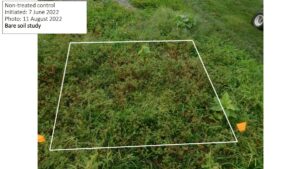
- Figure 1. Control plot with no mulch or herbicide. Photo by Brandon McNally.

-
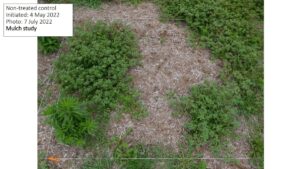
- Figure 2. Mulched plot with no herbicide. Photo by Brandon McNally

-

- Figure 3. Bare-soil with Sureguard SC (flumioxazin). Photo by Brandon McNally.

-
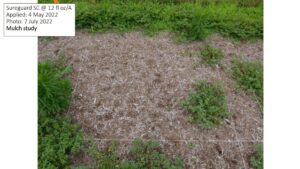
- Figure 4. Mulched plot with Sureguard SC (flumioxazin). Photo by Brandon McNally.

The Trial Methods
Researchers tracked weed suppression across both bare soil and mulched plots. The study evaluated six common active ingredient combinations:
- Flumioxazin (SureGuard vs. Broadstar)
- Isoxaben + trifluralin (Snapshot)
- Dimethenamid-P + pendimethalin (FreeHand)
- Prodiamine + isoxaben (Gemini)
- Indaziflam (Marengo vs. Specticle)
- Isoxaben + dithiopyr (Crew)
In the Midwestern sites (Indiana and Ohio), treatments were applied just once. In Florida, where a warm climate, high humidity, and prolonged rainy seasons trigger year-round weed pressure, the sites received a second application four months after the initial setup.
The Advantages of Mulch
One of the most interesting findings from the Indiana and Ohio trials was the overwhelming effectiveness of mulch alone.
In mulched plots across the Midwest, researchers noted no significant difference in weed cover between plots treated with a preemergence herbicide and those left entirely untreated. At two months after treatment (MAT), the physical barrier provided by the mulch was sufficient to suppress the vast majority of weed emergence. Furthermore, the specific formulation (liquid vs. dry) yielded no notable interaction or main effect on weed cover when sitting on top of a healthy layer of mulch.
However, the story changed entirely when mulch was omitted:
- Bare Soil: In unmulched, bare-soil Midwestern plots, the untreated control plots quickly exploded to 98% weed cover at the two-month mark.
- Herbicide Effectiveness: Most of the tested PRE herbicides offered significant advantages, holding weed cover down to between 35% and 52%.
- The Granular Options: Not all formulations performed equally in bare soil. Dry-applied (granular) formulations of flumioxazin resulted in 88% weed cover, while dry-applied indaziflam resulted in 74% weed cover, thus proving less effective than their liquid options.
The Challenges of Florida’s High Weed Pressure
While mulch alone was effective in cooler climates, the tropical and subtropical environments of Florida told a completely different story. High rainfall and persistent warmth break down herbicides rapidly and accelerate weed seed germination, making a single layer of mulch insufficient.
Two months after the second application in Florida, weed pressure cracked through many standard treatments, but certain products and formulations stood out:
- Top Performers: Liquid-applied indaziflam, along with both the liquid and dry formulations of flumioxazin and dimethenamid-P + pendimethalin, maintained more effective control, keeping weed cover under 23%.
- Reducing Efficacy: In contrast, the remaining chemical combinations saw their efficacy decline significantly, resulting in 30% to 39% weed cover, which was statistically identical to the completely untreated control plots (which sat at 39% weed cover).
Liquid vs. Granule Differences
The study highlights that liquid-applied preemergence herbicides generally outperform dry granular options, particularly in bare soil or high-pressure scenarios.
Granular herbicides rely on localized distribution; if a granule does not sit in immediate, close proximity to a germinating weed seed, the seedling can safely “escape” the chemical barrier. Achieving perfect uniformity with dry granules can be difficult. On the other hand, liquid sprays provide a uniform chemical barrier zone across the soil surface, resulting in more consistent coverage and superior weed suppression.
Takeaways for the Green Industry
This research offers practical guidance for property managers looking to optimize their chemical budgets and labor efficiency:
- Don’t Skimp on Mulch in the Midwest: If you are operating in regions like Indiana or Ohio and maintain a clean, three-inch-deep mulch layer, adding a routine preemergence herbicide may not offer an immediate economic return on investment under low weed pressures. Focus the chemical applications for areas where mulch is thin, absent, or susceptible to weed breakthroughs.
- Go Liquid When Mulch is Missing: If you are treating bare soil, edge beds, or tree rings without mulch, prioritize liquid spray-applied preemergence options. Granular versions of hard-hitting options like flumioxazin and indaziflam drop significant efficacy when they aren’t backed up by a mulch barrier.
- Always make applications in the South: In southern environments like Florida, chemical applications are a must, even if you mulch. Landscape managers must rely on multiple, split-applications and should lean heavily on liquid indaziflam, flumioxazin, or dimethenamid-P + pendimethalin to successfully navigate brutal weed seasons.