Earlier this year, Ohio expanded its quarantine for box tree moth (Cydalima perspectalis) to include seven additional counties, bringing the total number of quarantined counties in the state to 14 (ODA, 2026). Michigan currently has 13 counties under quarantine as well. Although this invasive pest has not yet been detected in Indiana, populations close to our borders are continuing to spread. It is important to remain vigilant, particularly in the northeastern and southeastern regions of the state where the risk of introduction is greatest. Landscape professionals, nursery workers, and homeowners can all assist with early detection by monitoring boxwood plantings for signs of infestation.
Signs and Symptoms
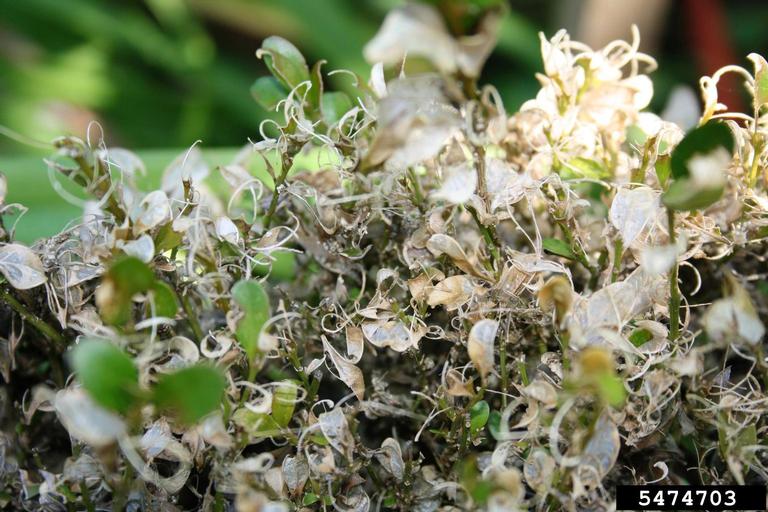
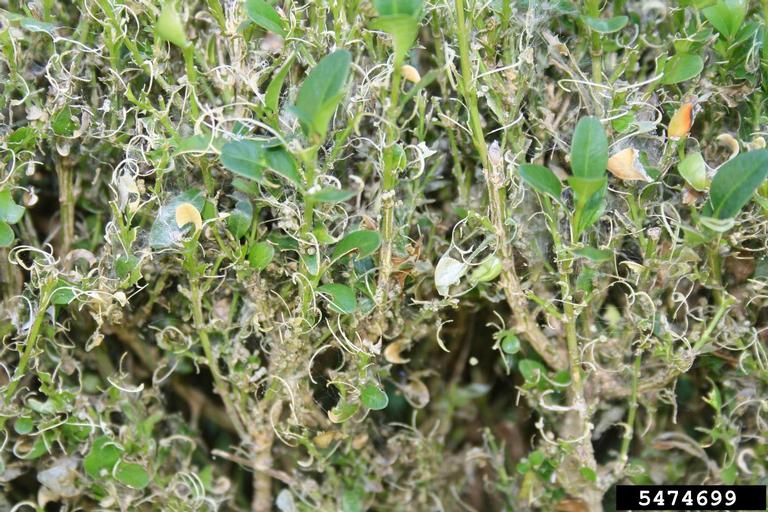
The caterpillar stage of box tree moth is responsible for the damage to boxwoods. Caterpillars are aggressive foliage feeders and often leave behind only the leaf margins or midribs, giving damaged plants a characteristic “stringy” appearance (Figs. 1, 2). As they feed, the larvae also produce large amounts of webbing throughout the shrub canopy.
One of the challenges in detecting infestations is that damage often begins deep within the interior of the shrub. Boxwoods may appear healthy from the outside even while caterpillars are actively feeding inside the canopy. As feeding progresses outward, severe defoliation can develop rapidly. When scouting plants, carefully inspect interior branches for webbing, brown or dried leaves, and feeding injury.
Identification
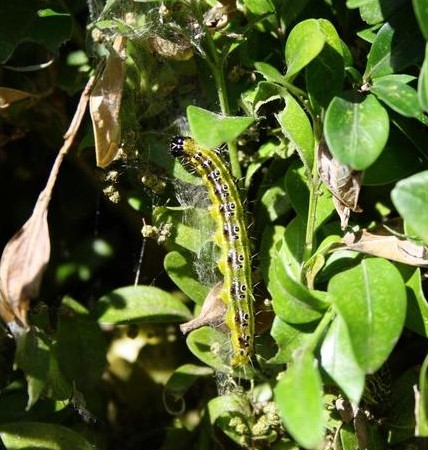
Box tree moth caterpillars are bright yellow-green with black stripes and rows of black spots running the length of the body (Fig. 3). This is the time of year when the caterpillars are active, so take a few minutes to check any boxwoods for them.
Adult moths are primarily night fliers, so they are less commonly observed during the day. Adults are typically white with broad brown wing borders and a distinctive white crescent-shaped marking within the brown band on the forewing (Fig. 4).
-

- Fig. 1 Boxwood damage from box tree moth. Photos by Ferenc Lakatos, University of Sopron.
-

- Fig. 2 Boxwood damage from box tree moth. Photos by Ferenc Lakatos, University of Sopron.
-

- Fig. 3. Box tree moth caterpillar. Photo by Ferenc Lakatos, University of Sopron.
-

- Fig. 4. Box tree moth adult. Photo by Szabolcs Sáfián, University of West Hungary.