Scale Spotlight: Azalea Bark Scale
Have you noticed crusty white flecks or cottony patches building up along the stems and branch forks of an azalea or rhododendron? The culprit is likely azalea bark scale, Acanthococcus azaleae (Comstock). We received a sample of this scale at the Purdue Plant & Pest Diagnostic Lab earlier this month, and crawlers are getting ready to emerge in landscapes across the region. Now is good time to take a closer look at the azaleas in your yard or on the properties you manage. The white waxy sacs of azalea bark scale do a convincing impression of a mealybug, but this insect is neither a mealybug nor a true soft scale; it is in the family Eriococcidae, the felt scales, a third group of scales distinct from the armored and soft scales covered earlier in this series.
Spotting the problem
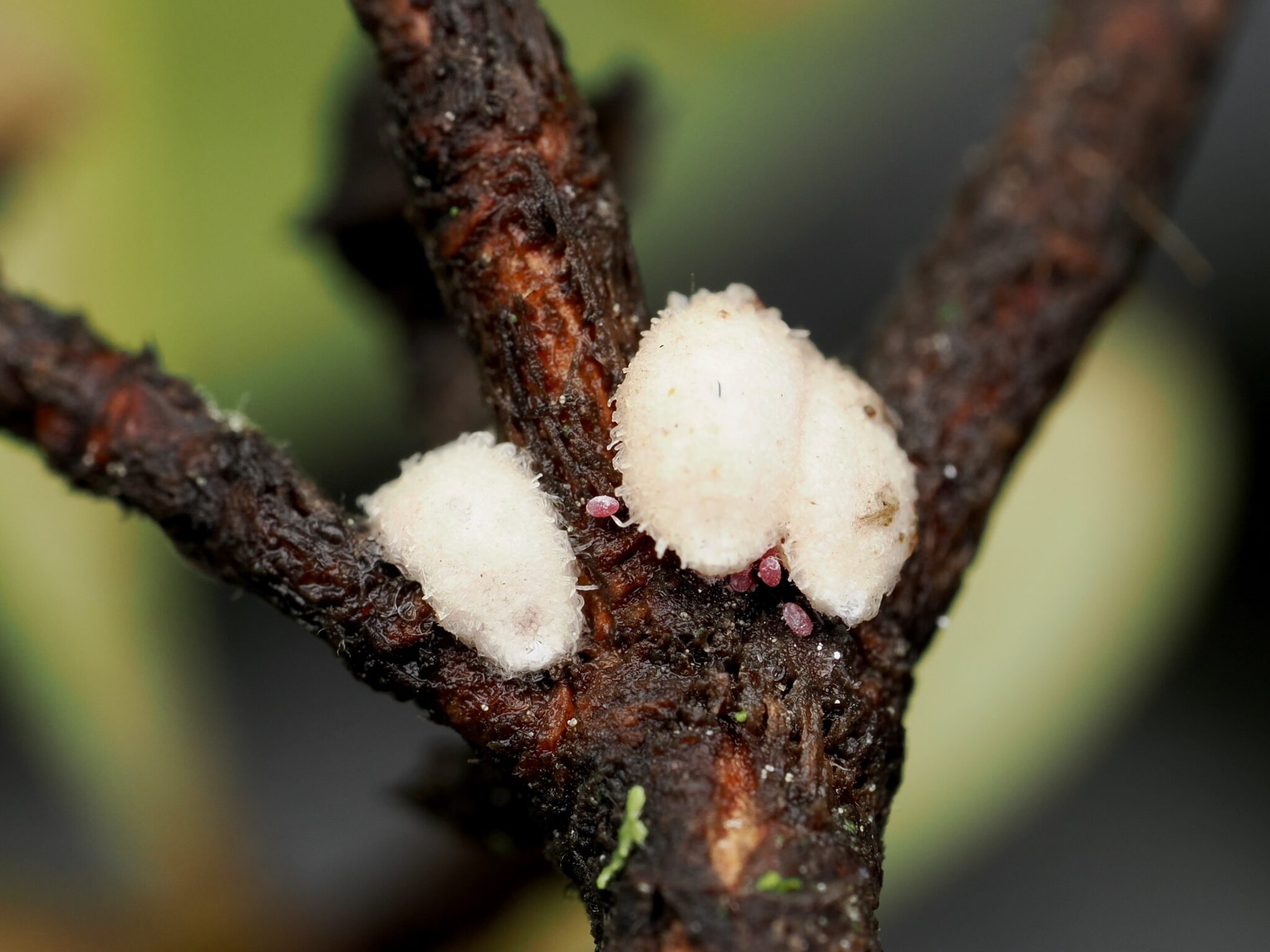
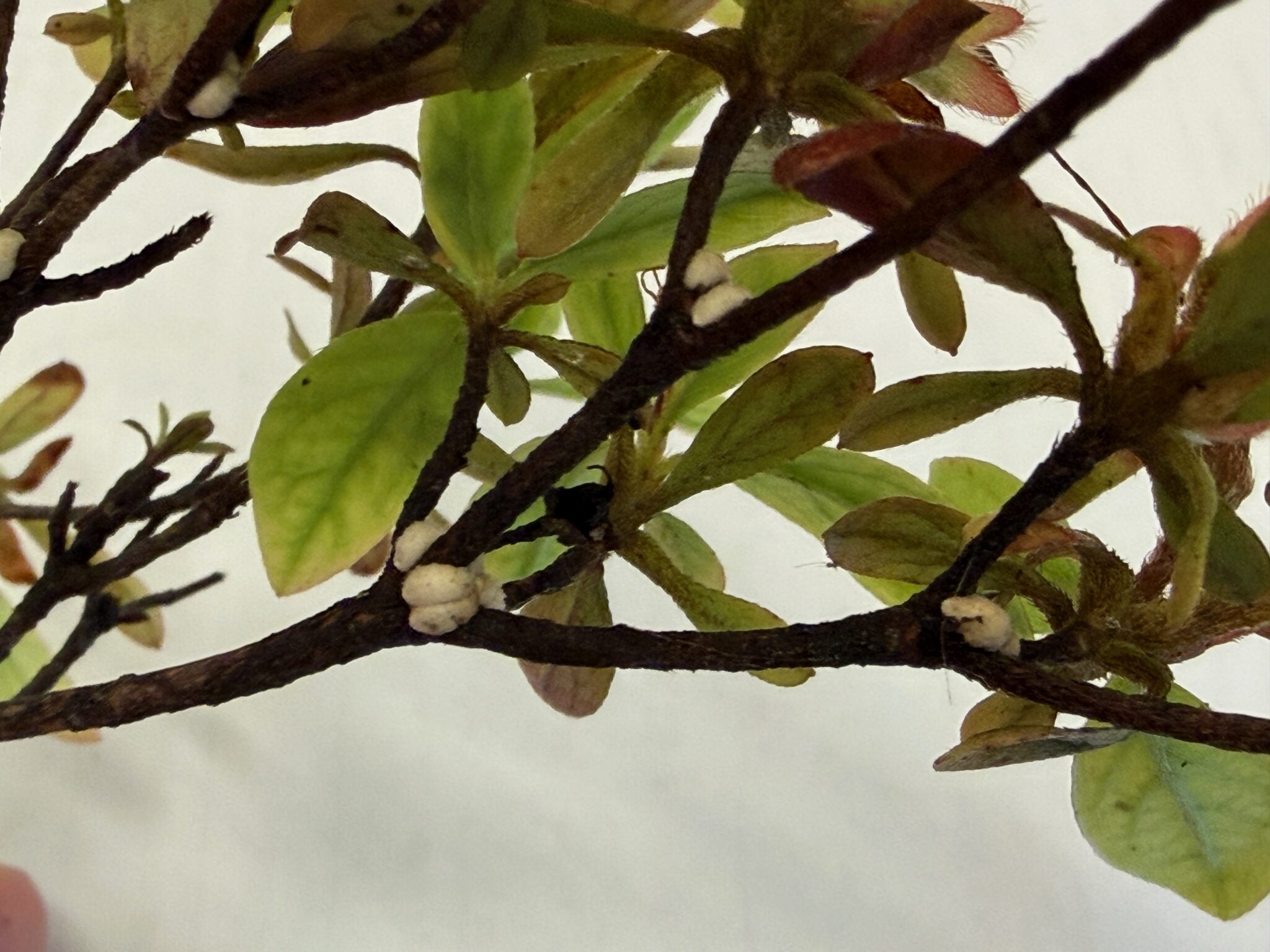
Adult females are roughly 3 mm long and dark purple, but you almost never see the insect itself. Instead, you see the protective white, felted egg sac the female builds around herself, typically concentrated in the crotches where branches divide and along the bark of older stems (Fig. 1). On a heavily infested plant the sacs can cluster densely up and down the twigs and look almost like a frost or a dusting of cotton. If you flip one open, the inside is unmistakable: the female and her clutch of eggs and crawlers are a bright red-orange that contrasts sharply with the white wax (Fig. 2). As the scales feed on phloem, leaves yellow and thin out, twigs lose vigor, and individual branches may die back. The scales also excrete copious honeydew, which supports sooty mold growth that blackens the stems and lower leaves and is often what first prompts a homeowner to investigate (Fig. 3). Heavy infestations can kill rhododendrons outright if left unmanaged for several seasons. Beyond azalea and rhododendron, hosts in our region include Japanese andromeda (Pieris japonica) and, less commonly, hawthorn, willow, and poplar.
-
- Figure 1. Azalea Bark Scale on azalea branch.
-

- Figure 2. Azalea Bark Scale removed from plant, showing the sack-like female and many of her eggs.

-
- Figure 3. Infestation of Azalea Bark Scales showing typical distribution of scales on the plant.
Life cycle and timing
Azalea bark scale overwinters as immature nymphs feeding on the bark of its host. The nymphs mature in spring, and adult females begin producing their conspicuous white egg sacs by mid- to late spring. Tiny red crawlers hatch and disperse from late June through July in our region — with some year-to-year and site-to-site variability — so the most reliable approach is to watch known-infested plants for active crawler movement rather than rely on a fixed calendar date. Indiana sees a single generation per year; further south, a partial second generation can occur.
Management
Crawler emergence is the window when control is most effective. Once a crawler settles and the female begins constructing her waxy sac, contact insecticides have a hard time penetrating. During active crawler movement, a 2% horticultural oil or an insecticidal soap applied with thorough coverage is generally effective, with a follow-up application two to three weeks later to catch crawlers that hatched after the first treatment. For severe or recurring infestations, a soil-applied systemic such as dinotefuran or imidacloprid in early spring provides season-long suppression, but these products should be timed carefully on flowering rhododendrons and azaleas to minimize pollinator exposure. Pruning out heavily encrusted twigs in late winter, before the overwintering nymphs mature, reduces the source population and improves the results of any follow-up treatment. Naturally occurring predators and parasitoid wasps can keep light infestations in check, so it is worth avoiding broad-spectrum insecticide use that would knock these beneficials back. A full guide on scale management is available in the Purdue Extension fact sheet Scale Insects on Shade Trees and Shrubs (E-29).
Take a closer look at your azaleas
Azalea bark scale is easy to overlook in its early stages and easy to mistake for something else once it becomes conspicuous. If you have an azalea, rhododendron, or andromeda that looks thinner than it should or has developed crusty white patches along the stems, take a closer look — and submit a sample to the Purdue Plant & Pest Diagnostic Lab if you would like a confirmed identification before deciding on a treatment plan.