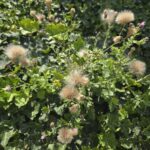
As summer comes to a close, plants are rapidly releasing seeds and the most noticeable are the flying fluffy type. Thistles, asters, and milkweed are just a few of the summer-flowering plants that depend on the wind to disperse their seeds, sometimes carrying them miles away to potentially suitable locations, though seeds typically land with…Read more about What the Fluff?![Read More]
Resources for landscapes and gardens in the Midwest
Landscape Report
weed control

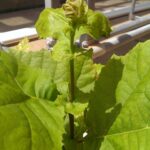
In the last newsletter, an article on triclopyr (www.purduelandscapereport.org/article/the-summer-of-triclopyr-mounting-evidence-for-off-target-damage/) brought up much discussion on the Roundup brands now containing multiple active ingredients other than glyphosate. Professionals in the industry may encounter a client with herbicide damage symptoms that mimic growth-regulator injury instead of typical glyphosate damage symptoms. While the client may have used Roundup, they…Read more about When Roundup Isn’t Roundup: Clearing up the confusion between products[Read More]
A recent conversation with a landscaper about tank mixing led to a brief discussion about glyphosate products with a contact herbicide included. I thought I would share my thoughts on the addition of contact herbicides and its effectiveness on weed control. We all know that we live in a microwave society. Most people want things…Read more about Does weed control improve with adding a contact herbicide to glyphosate?[Read More]

Biology: Pineapple weed (Matricaria matricariodies), behaves as either a summer or winter annual and it is commonly found throughout the United States. It is a weed of both high- and low-maintenance turfgrass lawns, landscapes, and nursery crops. Its ability to tolerate low mowing heights and highly compacted soils allow pineapple weed to compete with in weak…Read more about Spotlight on Weeds: Pineapple weed[Read More]

Surflan (oryzalin) is a part of many preemergence weed control programs. Being in the dinitroaniline (DNA) herbicide family (along with trifluralin, pendimethalin, prodiamine, and others), this product controls many weeds with minimum phytotoxicity to landscape plants. Oryzalin is also on the lower end of preemergence herbicide pricing, thus increasing the use of this product. You…Read more about What Happened to Surflan (oryzalin)?[Read More]

Phytotoxicity is damage to plants caused by chemicals, fertilizers, or pesticides. Phytotoxicity can be a positive (killing weeds) or a negative (damage from pesticides on ornamental plants), depending on the intended results. Some of the common phytotoxic effects can show symptoms such as stunting of leaves and whole plant, necrosis (death), chlorosis (yellowing), abnormal growth…Read more about Diagnosing Phytotoxicity on Landscape Plants[Read More]

Diagnosing herbicide injury on ornamental plants can be difficult due to the sheer number of cultivated plants and the number of active ingredients used around ornamentals. Modern cultivars of ornamental plants include characteristics much different from the species, so it’s important to know ‘normal’ to properly diagnose a problem. There are several reasons that herbicide…Read more about Diagnosing Herbicide Injury on Ornamentals[Read More]

As bud break is currently occurring on early species in southern and central Indiana, remember to be on the lookout for callery pear (Pyrus calleryana) on properties that you manage for removal. Callery pear (multiple cultivars in the landscape from this species) has become a major invasive species of concern in wild and disturbed areas…Read more about Annual Reminder to Identify Callery Pear for Removal[Read More]

Preemergence herbicides should be the primary tool for a landscape weed control program. The primary reasons to develop a strong preemergence herbicide program are 1) Decreased phytotoxicity (plant damage) to landscape plants and 2) Reducing the amount of times required to visit a property. With the difficulty of attracting quality labor in our industry, time…Read more about Single or Split Application of Preemergence Herbicides: Controlling while extending control[Read More]

Biology: Prostrate Spurge (Euphorbia humistrata) is a summer annual broadleaf weed that can be found in dry/sandy and/or nutrient-poor soils along with compacted, weakened or disturbed turfgrass and landscape sites. Look for it first in driveways and sidewalks or in potted plants in a landscape or nursery as temperatures start to get warmer. Prostrate spurge can also…Read more about Spotlight on Weeds: Prostrate Spurge (Euphorbia humistrata)[Read More]

Biology: Ground ivy (Glechoma hederacea), also known as creeping Charlie, is a very difficult to control perennial broadleaf weed. It can often be seen growing in the shade and invading turfgrass and landscapes throughout the United States. Ground ivy thrives in moist, rich soils located in shaded areas, but will grow in full sun as well….Read more about Spotlight on Weeds: Ground Ivy/Creeping Charlie (Glechoma hederacea)[Read More]

Biology: Purple deadnettle (Lamium purpureum) is a common winter annual broadleaf weed found throughout the US. It is closely related to another winter annual broadleaf, henbit (Lamium amplexicaule). Both have vibrant purple flowers that can been seen now in lawns, landscapes, and fields. To see more about henbit, refer to this article from last spring: https://purduelandscapereport.org///article/spotlight-on-weeds-henbit-lamium-amplexicaule/…Read more about Spotlight on Weeds: Purple deadnettle[Read More]

Biology: Yellow nutsedge (Cyperus esculentus), also known as chufa (chufa is a non-weedy variety that is used for wildlife food plots and is not a cold hardy weed like yellow nutsedge), nutgrass, or watergrass, is a troublesome, difficult-to-control perennial weed found throughout the United States. It is important to understand that yellow nutsedge is not a grass…Read more about Spotlight on Weeds: Yellow nutsedge (Cyperus esculentus)[Read More]

Fill in the blank: Apply crabgrass preemergence herbicide when____________is in bloom. If you said forsythia, you would be correct. Most of us have been told the answer to this for many years, but have you ever thought to yourself, ‘Is it true?’ There are many ways that people make decisions on when to apply herbicides. …Read more about Early Season Predictions: Methods to Predict Weed Emergence[Read More]
Sign-up to receive email news and alerts from Purdue Landscape Working Group:

This is US

For More Information

Purdue Home Page

Purdue Extension

Find your county office