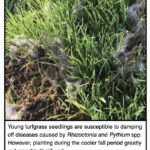
Summer 2024 was a stressful season for lawns in Indiana and throughout the region. Temperatures often spiked to uncomfortable levels, particularly towards the end of August, and were accompanied by either sweltering humidity or an abrupt halt to rainfall. Diseases such as brown patch on tall fescue were prevalent and leaf spot/melting out diseases on…Read more about Disease Worries on Lawn Seed and Seedlings?[Read More]
Resources for landscapes and gardens in the Midwest
Landscape Report
plant health care
August was National Check Your Tree Month, but this is something that every tree owner/manager should be doing year-round. As the last hot days of summer are finishing up and we look forward to cooler fall days, we can look to our trees for different signs of trouble. Most people tend to look up at…Read more about Enjoy Your Trees While Checking Them[Read More]

Identifying a plant problem is the first step to improve the health of plants in the landscape. We created a series of short (5 to 7 min) YouTube videos to help you learn or just brush up your plant diagnostic skills. Each video guides you through the diagnostic process in real landscapes, reviews pest biology…Read more about Learn to Diagnose Plant Problems with Quick Guide YouTube Videos[Read More]

Identificar qué problema tiene la planta es el primer paso para mejorar la salud de las plantas en el jardín. Hemos creado una serie de videos cortos (5 a 7 minutos de duración) en YouTube. Esto lo hemos hecho para ayudarlo a aprender o simplemente mejorar sus habilidades de diagnóstico de plantas. Cada video te…Read more about Aprenda a Diagnosticar Problemas de las Plantas con Videos en YouTube[Read More]

Hydrangea L. (family Hydrangeaceae Dumort) is an all-encompassing description of a group of herbaceous and woody flowering plants, composed of more than 80 species native to Asia (including Japan), Indonesia, the Americas. Popular hydrangea species include the bigleaf hydrangea (Hydrangea macrophylla), also known as French hydrangea, panicled (peegee) hydrangea (H. paniculata), oak-leaf hydrangea (H. quercifolia) and mountain hydrangea (H. serrata). Hydrangea…Read more about Viruses of Hydrangea[Read More]

Blight, Leafminers, and Moths: The Plight of Boxwoods Boxwoods (Buxus spp.) were introduced into the United States during colonial times, and still today they are one of the most popular evergreen shrubs used in landscapes. They are frequently selected for hedges and topiaries because they are easily trimmed into geometric shapes. They were also easy…Read more about Blight, Leafminers, and Moths: The Plight of Boxwoods[Read More]

I think white pines are beautiful trees, especially at maturity, and they have the added advantage that they are one of the few conifers that don’t try to kill you with their needles. Besides working with the foliage, have you ever had to “rescue” a child who climbed too high in a spike-infested deathtrap of…Read more about Declining Pines of the White Variety[Read More]

Mites are eight-legged arthropods who pierce plant cells to feed on them. Plants that are attacked by mites lose their green color and appear somewhat bronzed. Spider mites will make webs to help them forage on leaves unencumbered by irregular leaf surfaces. The accumulation of webs, and old skins of mites can give heavily infested…Read more about Tune up Your Spider Mite Management This Fall[Read More]

Dead man’s fingers is an apt moniker for a gruesome-looking fungus (Xylaria polymorpha and related species) that produces club-shaped fungal fruiting bodies that appear as fingers growing around the base of dying or dead woody plants and even wooden objects in soil (Fig. 1). With more than 25 species of Xylaria, generalizations are difficult to…Read more about Dead Man’s Fingers[Read More]

Many trees are planted for their beautiful fall color, especially in locations where the climate provides reliable autumn weather. I have said this multiple times during extension talks and conversations with submitters to the PPDL, but I seem to have not experienced a ‘normal’ fall since moving to Indiana with how erratic the weather has…Read more about Early Fall Color – A Symptom of Stress[Read More]

Wet summer weather always brings in a surplus of plant diseases, but few are as dramatic as clematis blight, caused by the fungus now called Calophoma clematidina (formerly Ascochyta or Phoma clematidina) (Fig. 1). The rest of us simply call it clematis blight or clematis wilt. Why the confusion with both the common and Latin…Read more about Blasted Clematis Blight[Read More]

Trees stressed by prolonged drought are more subject to attack by boring insects. This article provides tips and a video link on how to manage pines for borers. Record breaking heat and sporadic rainfall during July of 2023 took their toll on landscape trees. Cone bearing evergreens, like white pines, are especially susceptible to drought…Read more about Beat Back Borers Attacking Pines and other Cone Bearing Trees[Read More]

Phytotoxicity is damage to plants caused by chemicals, fertilizers, or pesticides. Phytotoxicity can be a positive (killing weeds) or a negative (damage from pesticides on ornamental plants), depending on the intended results. Some of the common phytotoxic effects can show symptoms such as stunting of leaves and whole plant, necrosis (death), chlorosis (yellowing), abnormal growth…Read more about Diagnosing Phytotoxicity on Landscape Plants[Read More]


Sign-up to receive email news and alerts from Purdue Landscape Working Group:

This is US

For More Information

Purdue Home Page

Purdue Extension

Find your county office