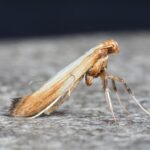
Many Hoosier landscapes include flowering plants known as beardtongue or simply by its scientific name, Penstemon. This is the largest genus of flowering plants that is endemic to North America, with some 280 species spread throughout the continent – at least 11 of which are native to Indiana. Many of the cultivars planted in gardens…Read more about Is your Penstemon stem swelling? It’s probably a moth![Read More]
Resources for landscapes and gardens in the Midwest
Landscape Report
Entomology
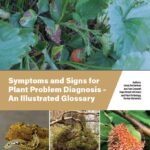
Do your landscape plants have cankers, mosaics, galls, mummies, or witches’ brooms? These and other symptoms are often difficult for the average homeowner to understand, let alone visualize. Purdue Extension staff can often assist with diagnosing plant diseases. Additionally, Purdue Extension specialists Janna Beckerman (retired) and Tom Creswell authored the publication, “Symptoms and Signs for…Read more about Plant Disease Symptoms You Could Notice in Your Home Landscape[Read More]
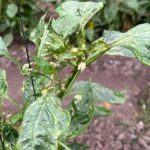
Nursery growers and landscapers should stay vigilant for an invasive thrips that is moving across the USA. Thrips parvispinus was first detected in Florida in 2020. It has since spread through Georgia and the Carolinas, and has been detected in Colorado, Ohio, Pennsylvania, and Delaware. It is not known to occur in Indiana, but growers…Read more about Invasive Thrips to Watch for in the Nursery and Landscape[Read More]
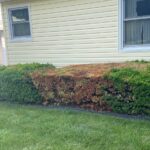
Yews are widely used as foundation plantings in many areas and are valued for their dark, evergreen foliage. The most widely used landscape yews are Japanese yew (Taxus cuspidata) and Taxus x media hybrids, such as Hicksii or Wardii Yew. While few diseases and insects attack yew, there are a few problems to watch for….Read more about What’s Killing My Yews? Top Problems and How to Prevent Them[Read More]
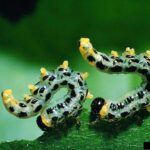
Sawflies are frequent pests in the landscape that attack a wide variety of plants, from ornamental flowers to large trees. You might start to see them damaging plants around this time of year as the first generations hatch and begin to feed on foliage. They are often mistaken for caterpillars, which are the larval stages…Read more about Sawflies: the caterpillar pests that are not caterpillars[Read More]
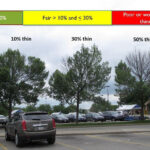
Recently, there has been an uptick in questions related to one of Indiana’s most notorious invasive pests: the emerald ash borer. Homeowners, businesses, even professionals have asked if ash trees are still present in Indiana, and if the insect is still a threat to our ecosystem. Emerald ash borer wreaked significant havoc among Indiana’s hardwoods,…Read more about Revisiting Ash Tree Protection[Read More]
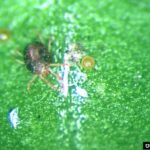
The bitter winter cold has finally passed us (or has it? It’s hard to tell in the Midwest)! The days are getting warmer and longer, and that means the insects are coming out of their overwintering stages. As you prepare for your landscaping and gardening this year, are you implementing preventative measures for pests? Now…Read more about Insects are waking up – are you prepared?[Read More]
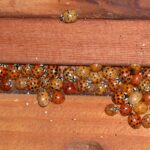
As the growing season winds down and cooler temperatures approach (despite today’s unseasonable 81 degrees F), many beneficial bugs begin searching for their winter hideaways. While many people see fallen leaves as just more plant waste to dispose of, some of our beneficial bugs see a cozy bed to bundle up in for the winter….Read more about Huddle Up and Hunker Down: The Winter Life of Beneficial Bugs[Read More]
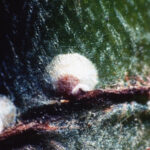
Recently, white prunicola scales (Pseudaulacaspis prunicola) were detected on Prunus during a DNR nursery inspection. This is a significant scale pest of woody ornamentals and fruit trees in eastern states, but it is currently not established in Indiana. It is primarily a pest of cherry, lilac, and privet species. Its total reported host range spans…Read more about Non-native armored scales[Read More]
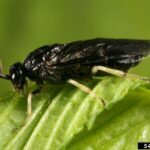
The elm zigzag sawfly (EZS), Aproceros leucopoda, is a non-native insect recently detected in several midwestern states. Originally from eastern Asia, this insect is rarely considered a problem in its native range, having several natural enemies and environmental factors able to keep it in check. However, when in new landscapes, aspects of this insect’s life…Read more about A New Threat to Elms in North America[Read More]
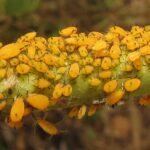
Milkweed is a popular choice in urban landscapes as more citizens engage with monarch conservation efforts and strive to maintain pollinator-friendly landscapes. This past month I have seen numerous images of aphids found on milkweed plants from all over the state. Homeowners are concerned that the infestation will negatively affect the monarch butterflies that rely…Read more about What are these small yellow bugs on my milkweed?[Read More]
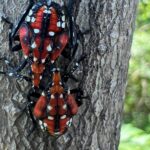
Recently a homeowner in Hamilton County posted on the Indiana Native Plant Society Facebook page with concerns about aphids, mites, and apple scab in her maple and oak trees. She asked for a second opinion and treatment options for these pests. I reached out to the homeowner and requested permission to collect samples from the…Read more about Case Study: Maple tree pests in the landscape[Read More]

Identifying a plant problem is the first step to improve the health of plants in the landscape. We created a series of short (5 to 7 min) YouTube videos to help you learn or just brush up your plant diagnostic skills. Each video guides you through the diagnostic process in real landscapes, reviews pest biology…Read more about Learn to Diagnose Plant Problems with Quick Guide YouTube Videos[Read More]

Identificar qué problema tiene la planta es el primer paso para mejorar la salud de las plantas en el jardín. Hemos creado una serie de videos cortos (5 a 7 minutos de duración) en YouTube. Esto lo hemos hecho para ayudarlo a aprender o simplemente mejorar sus habilidades de diagnóstico de plantas. Cada video te…Read more about Aprenda a Diagnosticar Problemas de las Plantas con Videos en YouTube[Read More]

Blight, Leafminers, and Moths: The Plight of Boxwoods Boxwoods (Buxus spp.) were introduced into the United States during colonial times, and still today they are one of the most popular evergreen shrubs used in landscapes. They are frequently selected for hedges and topiaries because they are easily trimmed into geometric shapes. They were also easy…Read more about Blight, Leafminers, and Moths: The Plight of Boxwoods[Read More]

Hoosiers are in for a special treat this spring. If you have lived in Indiana for more than a year, you have probably grown accustomed to the singing of cicadas in the later days of summer. However, in some years, cicadas will emerge in the spring. This occurred in 2021 when most of the state…Read more about Cicadas in Spring![Read More]

Mites are eight-legged arthropods who pierce plant cells to feed on them. Plants that are attacked by mites lose their green color and appear somewhat bronzed. Spider mites will make webs to help them forage on leaves unencumbered by irregular leaf surfaces. The accumulation of webs, and old skins of mites can give heavily infested…Read more about Tune up Your Spider Mite Management This Fall[Read More]

The 2023 Purdue Turf and Landscape Seminar will be held on November 16th and 17th at the W.H. Daniel Turfgrass Research and Diagnostic Center in West Lafayette, IN. This event is designed for intermediate and advanced turf and landscape professionals, providing them with the latest technology for managing turf and landscape systems, and to maintain…Read more about Purdue Turf and Landscape Seminar Announced[Read More]

A new invasive insect of concern has been identified in the state of Georgia. In August of 2023, Georgia’s Department of Agriculture, along with the USDA, confirmed the presence of the yellow-legged hornet, Vespa velutina, outside of the city of Savannah. To date, this is the only confirmed identification of this insect in the United…Read more about New Invasive Predator of Honeybees[Read More]
Sign-up to receive email news and alerts from Purdue Landscape Working Group:

This is US

For More Information

Purdue Home Page

Purdue Extension

Find your county office