An unfortunate question I am sometimes asked is similar to this: “I lost my prized shade tree! What can I plant that will grow fast and give me shade?” While there is no instant fix to this scenario, let’s review a few trees that might be better choices here in northern Indiana.
One obstacle to consider is that many of the fast-growing trees are also fast-dying, meaning that, relatively speaking, they are not long-lived for trees. We’re already behind the 8-ball in our highly manipulated landscapes because we know that trees in landscapes tend to live much shorter lives than trees in their unmanipulated natural habitats.
That said, here are a few trees to consider. I would still encourage homeowners to invest some time in researching the trees that they are considering. There are pros and cons to almost every tree, and there isn’t room in this article to fully explore all the advantages and disadvantages of each tree. Additionally, I will not be getting into detail about all the cultivars available.
Let’s start with our state tree, the Tuliptree (a.k.a Tulip-poplar or Yellow-poplar). Tuliptrees can become quite large and offer a pretty yellow fall color. They prefer deep, rich, well-drained soils.
If maples are on your mind, a couple of options would be Red maple and Freeman maple (a hybrid cross of Silver maple and Red maple). Red maple has more moderate growth. The Freeman maple is a faster grower and has stronger wood than one of its parents, the Silver maple. These maples do best in well-drained, slightly acid soils, but will tolerate a variety of soil conditions.
Northern catalpa is a fast grower, but dealing with the fruit litter, a long seed pod, may be a deterrent for some locations. It has large, heart-shaped leaves. It would grow well in moist sites.
Common hackberry is a fast grower, but it is susceptible to galls on the leaves (from a
n insect), and limbs can become susceptible to wind and ice damage. It tolerates a wide variety of soil conditions.
Thornless honeylocust is widely adapted to different soil types. Honeylocusts in the wild produce large thorns. The Thornless honeylocust is adapted to landscapes and allows dappled sunlight to reach turfgrass, so that it thrives more than it would under a tree that provides heavy shade.
-
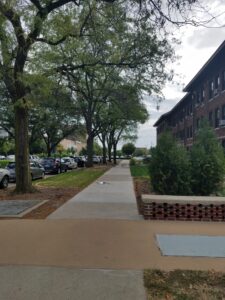
- Figure 1. Honeylocust is a fast growing tree that performs well in urban plantings.
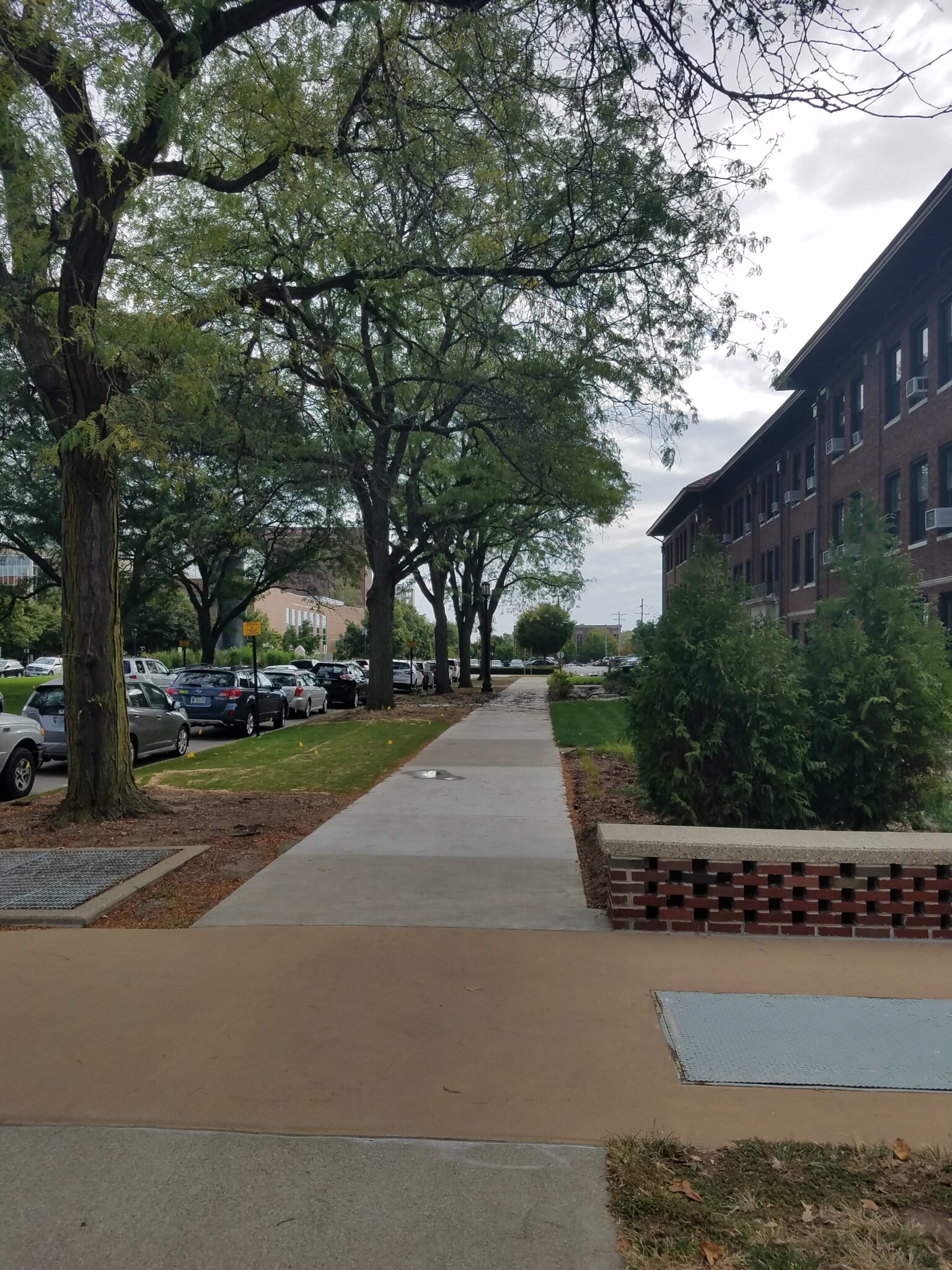
Sweetgum is also a fast-growing shade tree with brilliant fall colors. It has a star-shaped leaf. One drawback of sweetgum is the spiny seed capsule. This fallen fruit can make walking in the yard barefoot a painful experience.
Eastern cottonwood is the tree on record for the fastest growth rate of any tree native to the U.S. However, those with cottonwoods in their yard can tell you that the cottony seed mass shed in the spring sticks everywhere. It can be a mess. Plus, cottonwood can shed limbs frequently, especially after storms. This tree is commonly found along rivers and streams, so it not surprisingly prefers moist soils.
Also found along rivers and streams, American sycamore is a fast-growing tree in some landscapes. However, it can be a messy landscape tree, shedding bark, leaves, limbs, and fruit nearly year-round. The large fallen leaves can smother grass if not mowed or raked. It is also sensitive to a spring disease called anthracnose, which can cause defoliation and twig death.
Wild black cherry may be another good choice. Although it may not be available in some nurseries, it can be grown from seed. It prefers rich, moist, well-drained soils.
A couple of faster-growing oaks to consider are Pin oak and Northern red oak. Pin oak would be better suited to slightly wetter spots, while Red oak would work on a wider variety of soils, preferring rich, moist, well-drained sites. Pin oak is susceptible to iron chlorosis (yellowing leaves) on alkaline soils.
Finally, American basswood also prefers rich, moist, well-drained soils and is somewhat shade-tolerant. This tree can grow quite tall and provide excellent shade.
In your research, find out how large the tree you will be purchasing will get. One common planting mistake is locating trees too close to structures. Consider the mature size when placing it in the landscape.
Time your spring planting near Arbor Day, the last Friday in April.