For decades, many homeowners and gardeners bought lawn care products based strictly on brand-name recognition, expecting the formulation inside the bottle to remain identical over time. However, due to shifting corporate strategies, litigation risks, and regulatory pressures, several household pesticide giants have quietly overhauled their active ingredients. A recent prime example is Roundup. Historically synonymous with the powerful, non-selective herbicide active ingredient glyphosate, residential Roundup formulations sold in the U.S. no longer contain it. To mitigate future legal liabilities, manufacturer Bayer transitioned residential lawn and garden Roundup products to a mix of alternative active ingredients—such as triclopyr, fluazifop-p-butyl, diquat dibromide, or imazapic. Dabbing cut stumps in flowerbeds where there are sensitive plants to the new active ingredients has become an issue for non-suspecting homeowners.
A similar evolution occurred back in 2018 with the classic backyard insecticide Sevin dust. For more than a generation, Sevin relied on carbaryl, a broad-spectrum chemical belonging to the carbamate family. Today, if you pick up a standard container of GardenTech’s Sevin Insect Killer Dust at a local garden center, you are no longer purchasing carbaryl; the active ingredient has been swapped for bifenthrin, a synthetic pyrethroid derived from chemical structures found in chrysanthemums.
These massive compositional shifts underscore a critical rule of modern property maintenance: always read the label, even on highly familiar products. Because these household names have retained their legacy branding, using a newly formulated product the exact same way you used the old version can lead to severe, unintended consequences. For instance, a consumer assuming a new bottle of residential Roundup behaves exactly like old glyphosate might spray it around a tree or near certain landscaping, unaware that ingredients like triclopyr can seep into the roots of woody plants or linger in the soil far differently than glyphosate did. Similarly, changing from carbaryl to bifenthrin alters everything from specific target pests and application intervals to safety protocols around backyard livestock, poultry, and local pollinators. Assuming a product hasn’t changed just because the logo looks the same is a quick recipe for ruined lawns, unintended environmental runoff, or accidentally harming beneficial species.
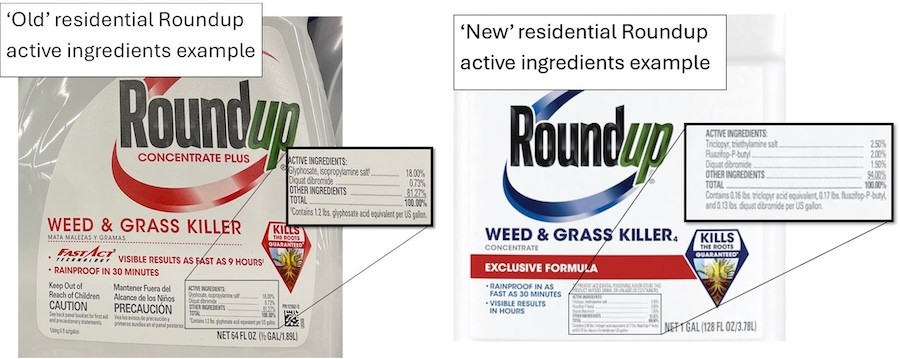
Photo credit: Bracken Henderson, University of Idaho Extension