This year, we have recently been finding Armillaria root rot at an increased frequency on Arborvitae samples submitted to the Purdue University Plant and Pest Diagnostic Lab. This is a fungal disease, caused by fungi in the genera Armillaria or Desarmillaria. Desarmillaria is a more recent name given to two species of basidiomycetes (2018 and 2022) so you may see publications referencing either Armillaria or Desarmillaria. For our purposes we are lumping them together.
-
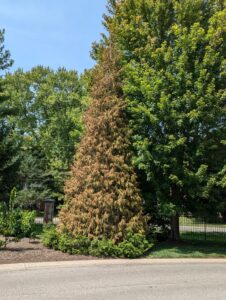
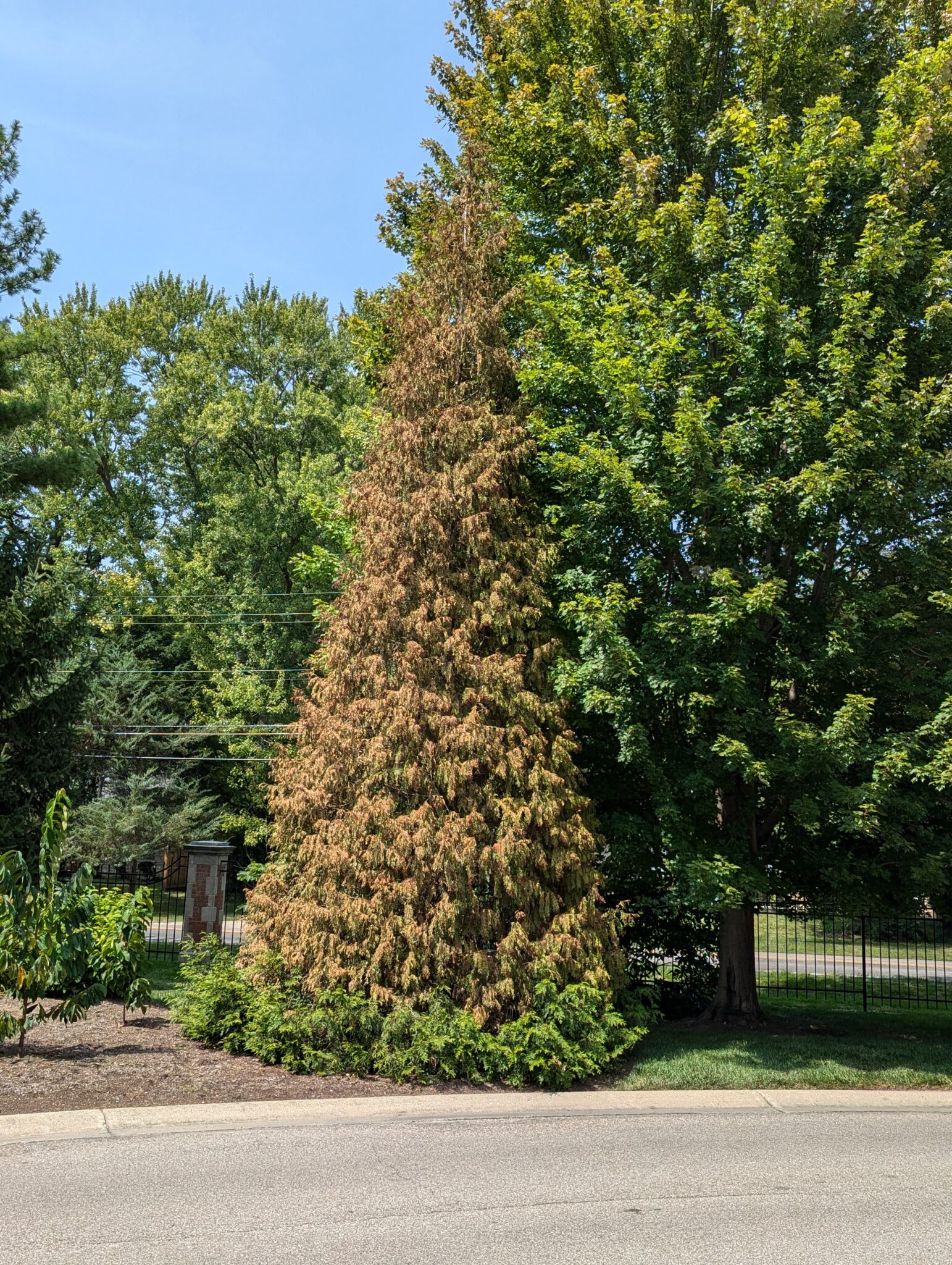
- Figure 1: An arborvitae in decline which is caused by multiple factors, including Armillaria root rot. Photo Credit: PPDL
-
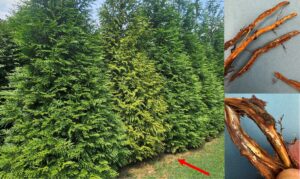
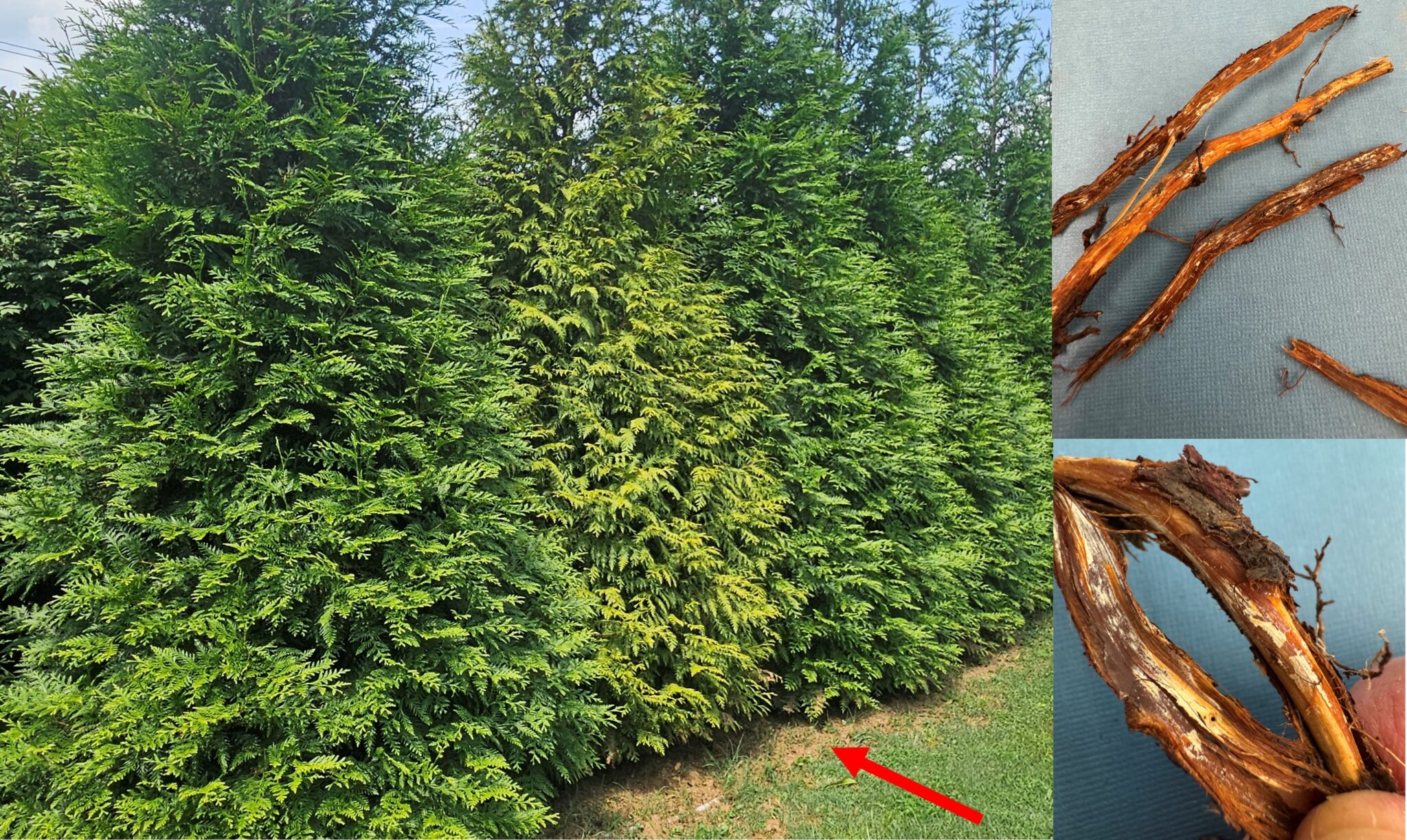
- Figure 2: The middle arborvitae (red arrow) is beginning to decline due to environmental and root stress. Roots were collected and submitted to the lab. Peeling back the outer bark of rotten roots reveal mycelial growth of Armillaria. Photo Credit: PPDL
Armillaria spp. are common soil inhabitants and can infect a very wide host range including most woody trees and shrubs. Some tree species may be more tolerant or even resistant to infection (like pine or larch), but no woody plant species is known to be immune to Armillaria. Oaks are known to be one of the more susceptible and commonly infected tree species.
Armillaria root rot is more commonly found on older plants or plants that have been under stress from adverse growing conditions, however, Armillaria can be an aggressive pathogen under the right conditions. Plants infected while small may die quickly, while older or mature plants may withstand infections for several years. Infected mature plants may decline slowly for years, then succumb during a periods of stress.
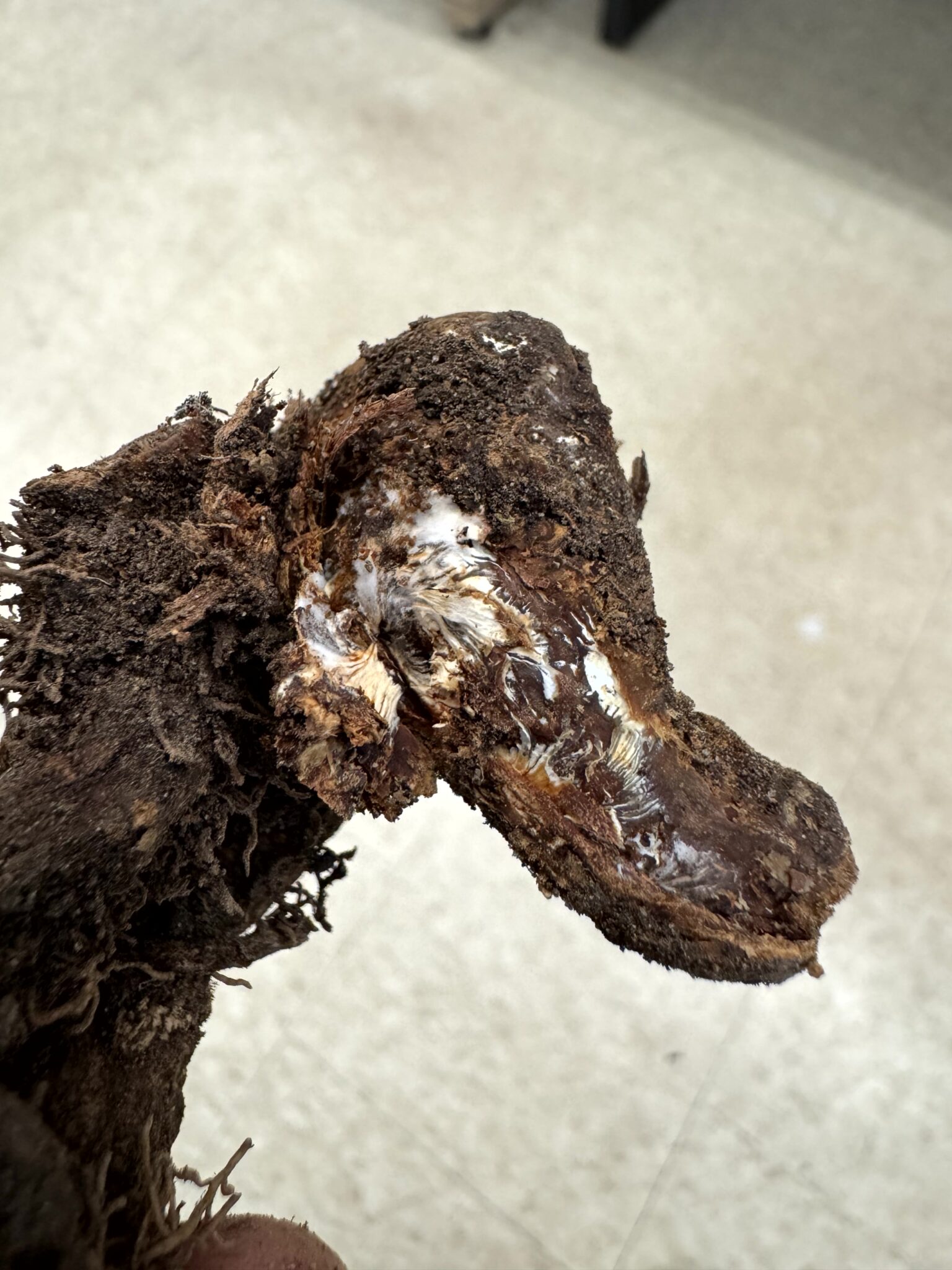
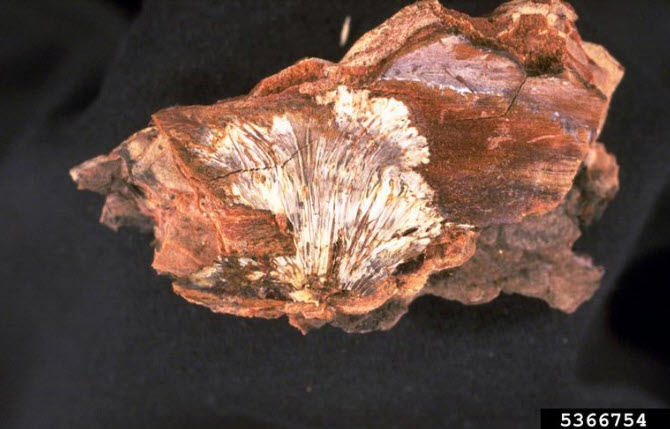
Above-ground symptoms in evergreens may include fading of color, resin flow at the base (conifers), individual branches dying and overall decline in vigor. Infections start in young roots and spreads to larger woody roots. In the early stages of infection, the roots can have a water-soaked appearance and become soft and spongy. Pencil-sized roots or larger may have loose outer bark and a layer of white fungal growth between the bark and the wood below. The fungus causes a white rot in the wood which can reduce tree stability/structural integrity.
-
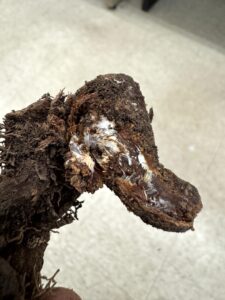
- Figure 3: Signs of Armillaria below the exterior of rotten Lilac roots Photo Credit: PPDL
-
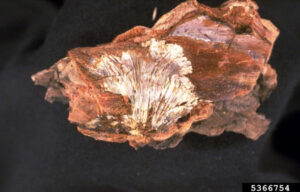
- Figure 4: Mycelial fan of Armillaria growing up the trunk of a conifer. Photo Credit: William Jacobi, Colorado State University, Bugwood.org
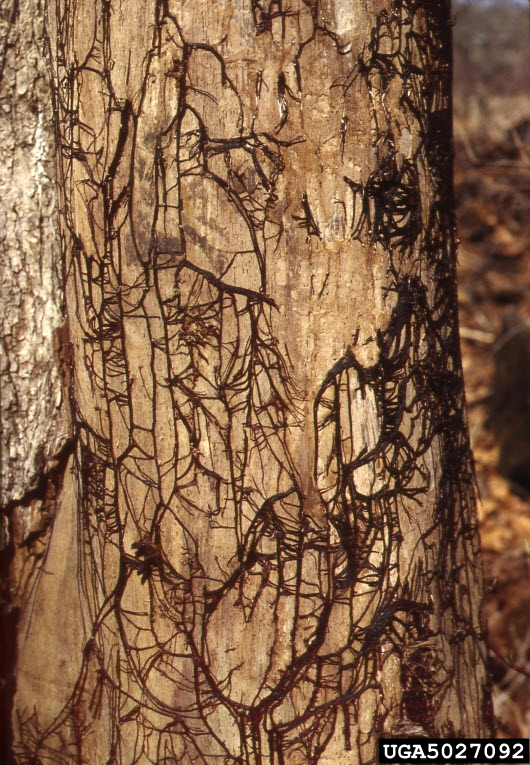
Some species of Armillaria may produce dark rhizomorphs (dense strings of mycelium) that look like black shoestrings under the bark or in nearby soil, lending to the other common name for the disease, “shoestring root rot.” Rhizomorphs grow through the soil from infected trees, roots, or old stumps to infect roots of other trees.
Clusters of honey-colored, gilled mushrooms may appear near the base or roots of infected hardwoods in the fall, but these may be absent or inconspicuous on evergreens. Mushrooms typically develop in clusters along the roots of the affected tree, potentially cropping up in grass a few feet away from the trunk. Multiple Armillaria species have variable cap coloration, from white to light tan or darker. Gills, found on the underside of the cap, are attached to and may even extend down the stem. Some species may have a persistent ring on the stem below the cap.
Options for managing Armillaria root rot are very limited. Most infections are noticed when trees or shrubs are in serious decline or have died. Once Armillaria root rot is confirmed in a location, disease prevention is fairly difficult, so cultural practices that mitigate stress (wound prevention/protection, mulching, irrigation during the summer) are the few options that are left. Dead or dying plants should be removed promptly to avoid attracting wood-boring insects. When removing plants killed by Armillaria root rot, it’s important to dig out as many of the infected roots in addition to the stump as possible. However, digging out the soil to remove the fungus is impractical.
Replanting can be problematic because Armillaria can survive for many years in dead roots or stumps or as rhizomorphs in the soil. Because most trees and shrubs are susceptible, consider replanting with ornamental grasses or other perennials. There is no soil treatment to rid the soil of the fungus.
-
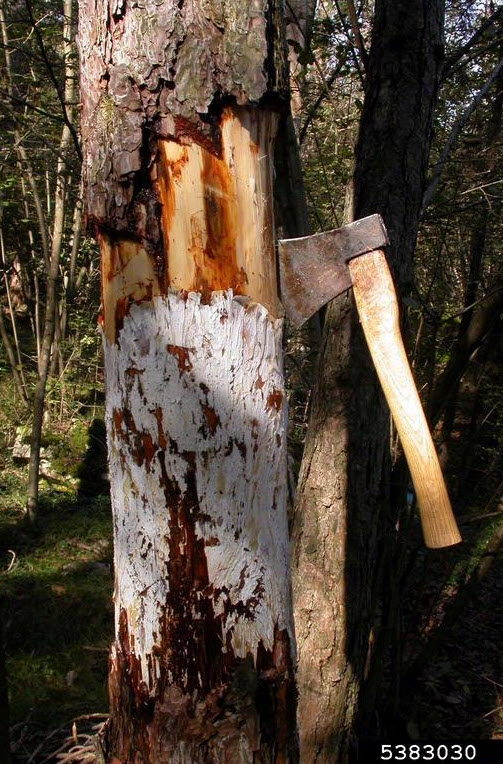
- Figure 5: Armillaria can colonize all of the dead wood in a tree, contributing to wood decay and breakdown. When infecting a living, highly susceptible plant, the fungus may spread high up the trunk as shown in this image. Photo Credit: Fabio Stergulc, University di Udine, Bugwood.org
-
- Figure 6: Armillaria produces root-like structures of condensed hyphae, called Rhizomorphs. These develop long after the tree has been initially infected. Photo Credit: Joseph Obrien, USDA, Bugwood.org
Selected References:
Kuo and Methven, Mushrooms of the Midwest, 2014. University of Illinois Press
Sinclair and Lyon, Diseases of Trees and Shrubs, 2nd Edition, 2005. Cornell University Press.