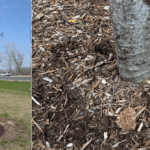
Tree care, in many cases, can be expensive if you require the assistance of an arborist for pruning or removals. Extreme weather events, characterized by extensive rain and wind, can cause damage to the canopy or, in worst-case scenarios, lead to tree failure. In cases of failures, weather is often the final push to already…Read more about Simple Steps to Care for Your Tree: Mulching[Read More]
Resources for landscapes and gardens in the Midwest
Landscape Report
tree maintenance

I think white pines are beautiful trees, especially at maturity, and they have the added advantage that they are one of the few conifers that don’t try to kill you with their needles. Besides working with the foliage, have you ever had to “rescue” a child who climbed too high in a spike-infested deathtrap of…Read more about Declining Pines of the White Variety[Read More]

When transplanting trees, it is important to consider the long-term viability. Since the typical life span of an urban tree is 7-20 years (USDA), proper establishment techniques are very important to decrease this mortality rate. When a tree becomes established, it is much more difficult to correct below ground problems. Root deformations can occur for…Read more about Using Pneumatic Digging Equipment to Correct Root Deformations, Deep Planting, and Compaction on Established Trees[Read More]


Phytotoxicity is damage to plants caused by chemicals, fertilizers, or pesticides. Phytotoxicity can be a positive (killing weeds) or a negative (damage from pesticides on ornamental plants), depending on the intended results. Some of the common phytotoxic effects can show symptoms such as stunting of leaves and whole plant, necrosis (death), chlorosis (yellowing), abnormal growth…Read more about Diagnosing Phytotoxicity on Landscape Plants[Read More]

Finally, spring has sprung and summer is on its way. The hot days and warm nights are welcome for us, but summer isn’t always so kind to our trees, especially in our urban forest and landscapes. Trees are dynamic living organisms that respond to external stimuli in very strategic ways and each season presents its…Read more about Summer Tree Care[Read More]

Pruning is an important maintenance practice on trees that is discussed a great deal. An essential part of making the pruning cut properly is the ability to identify the parts of a branch. Identification of the branch bark ridge and branch collar are vital to severing the branch in a place that facilitates fast and…Read more about Branch component identification for better pruning cuts[Read More]

Sign-up to receive email news and alerts from Purdue Landscape Working Group:

This is US

For More Information

Purdue Home Page

Purdue Extension

Find your county office