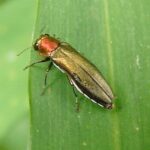
We are often the bearers of bad news when a new exotic insect species is discovered in Indiana. This time, however, we have some good news to share. Agrilus smaragdifrons, a beetle that feeds exclusively on Tree-of-Heaven (Ailanthus altissima), was detected in Indiana last year in Allen County. You might notice that this beetle belongs…Read more about Beetle that attacks Tree-of-Heaven found in Indiana[Read More]
Resources for landscapes and gardens in the Midwest
Landscape Report
Invasive

Register now for the Indiana Invasive Species Conference! September 4-5 at the South Shore Indiana Welcome Center-Hammond, IN Early bird registration ends July 20th Registration fees: Early bird registration: $80 per person (until July 20th) General registration: $95 per person (July 21st – August 15th) Student research poster presenters: $50 (Interested in presenting a poster? Contact…Read more about Register now for the Indiana Invasive Species Conference[Read More]
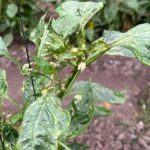
Nursery growers and landscapers should stay vigilant for an invasive thrips that is moving across the USA. Thrips parvispinus was first detected in Florida in 2020. It has since spread through Georgia and the Carolinas, and has been detected in Colorado, Ohio, Pennsylvania, and Delaware. It is not known to occur in Indiana, but growers…Read more about Invasive Thrips to Watch for in the Nursery and Landscape[Read More]
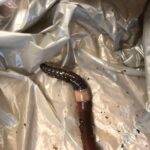
It’s that time again! With the arrival of warm temperatures and increased rainfall, many of us are getting to work on our lawns, gardens, and landscaping. Unfortunately, this often comes with discovering what new (or old) invasive species are here to haunt us. So far this year, the invasive I’ve gotten the most questions on…Read more about Asian Jumping Worms: How to ID this soil pest[Read More]
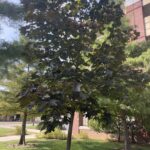
These three maples have somewhat similar-looking leaves. On the surface, you may think this is simply an academic exercise. But if you care about invasive plants and local ecology, this distinction is an important one. Norway maple is an invasive tree species, while sugar and black maples are native tree species (sometimes called hard maples)….Read more about Distinguishing Between Norway, Sugar, and Black Maples[Read More]
Some of you may recall news in 2020 about unsolicited seeds being sent in the mail from overseas (https://www.purdue.edu/newsroom/archive/releases/2020/Q3/unsolicited-seeds-could-wreak-havoc-on-agriculture,-environment,-state-officials-warn.html). There have now been recent reports of this happening again. Ric Bessin, Entomology Extension Specialist, and Joe Collins, Deputy State Entomologist, from the University of Kentucky, wrote about reports of unsolicited seeds from the south,…Read more about More Reports of People Receiving Unsolicited Seeds[Read More]
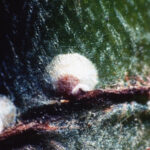
Recently, white prunicola scales (Pseudaulacaspis prunicola) were detected on Prunus during a DNR nursery inspection. This is a significant scale pest of woody ornamentals and fruit trees in eastern states, but it is currently not established in Indiana. It is primarily a pest of cherry, lilac, and privet species. Its total reported host range spans…Read more about Non-native armored scales[Read More]
In the last newsletter, an article on triclopyr (www.purduelandscapereport.org/article/the-summer-of-triclopyr-mounting-evidence-for-off-target-damage/) brought up much discussion on the Roundup brands now containing multiple active ingredients other than glyphosate. Professionals in the industry may encounter a client with herbicide damage symptoms that mimic growth-regulator injury instead of typical glyphosate damage symptoms. While the client may have used Roundup, they…Read more about When Roundup Isn’t Roundup: Clearing up the confusion between products[Read More]
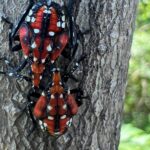

Most people these days have, at the very least, heard of Callery and Bradford pear trees and know something about the invasiveness of this ornamental street tree. But I still get questions about what it is and why it’s so bad. So, I’d like to offer a little history of this infamous tree. Where did…Read more about Invasive Bradford/Callery Pear: Why it is so detrimental and what to plant instead.[Read More]

Asian bush honeysuckle (Lonicera spp.) is an extremely invasive plant that is a serious problem in most areas of the Midwest. These invasive plants grow very fast, especially along woodland edges, and shade out most of the understory plants that are found in these areas. Honeysuckle can also significantly reduce the available browse for deer…Read more about Consider Fall Eradication of Asian Bush Honeysuckle[Read More]

It’s that time of year when we remind everyone to watch for spotted lanternfly (SLF) infestations. Spotted lanternfly is an invasive insect first detected in Pennsylvania in 2014, and has since spread throughout the eastern USA. Its preferred host is the invasive Tree-of-Heaven, but it also feeds on a wide range of important plant species,…Read more about Spotted lanternfly egg hatch is here[Read More]

The hemlock woolly adelgid (Adelges tsugae) continues its eastward spread across the US. In 2022, seven new counties were added to the distribution map of this invasive insect. While it is not present in Indiana yet, it is confirmed throughout the eastern USA from northern Georgia to Maine, extending west into Michigan, Ohio, and Kentucky….Read more about Hemlock Woolly Adelgid: Distribution update[Read More]

The problem There is another invasive species close to Indiana that landscaping and nursery professionals should look for. Box tree moth (Cydalima perspectalis) is native to East Asia, and was first detected in 2021 in New York. Detections in Michigan in 2022 have resulted in a quarantine zone for boxwoods (Buxus spp.) in the state….Read more about Box tree moth on Indiana’s doorstep[Read More]


EAB University is about to start its fall semester, bringing you the information you need about emerald ash borer and other invasive pests and diseases that are now impacting our trees, forests and woodlands. Here’s a schedule of the webinars we have locked in so far. We will update you if other webinar presentations become…Read more about Exotic Forest Pest Webinar Series to Start Fall Session October 20.[Read More]

Learn how to protect Indiana from invasive species at a free workshop. Professor Cliff Sadof of Purdue University and Carrie Tauscher, Arboretum Director of the Crown Hill Heritage Foundation will show you the best way to look for and report invasive species and provide a chance to practice reporting on the Crown Hill Grounds. Whether…Read more about Free Early Pest Detector Workshop[Read More]

All plants can fall victim to insects, diseases, and environmental problems. How they respond to this stress is often the same: Wilting, yellowing, holes, rots, blight—it’s a long list! With so much overlap in symptoms, it can be quite a challenge for people to identify their plant health problems accurately, quickly, and inexpensively. The Purdue…Read more about Plant Problems? There’s a mobile-friendly website for that![Read More]
Sign-up to receive email news and alerts from Purdue Landscape Working Group:

This is US

For More Information

Purdue Home Page

Purdue Extension

Find your county office