Is anyone else experiencing the annual invasion of Asian lady beetles (Harmonia axyridis)? Or perhaps you’re dealing with brown marmorated stink bugs? I haven’t seen many of those where I live, but I more than make up for it with the number of Asian lady beetles that choose my house as their winter vacation destination every year.
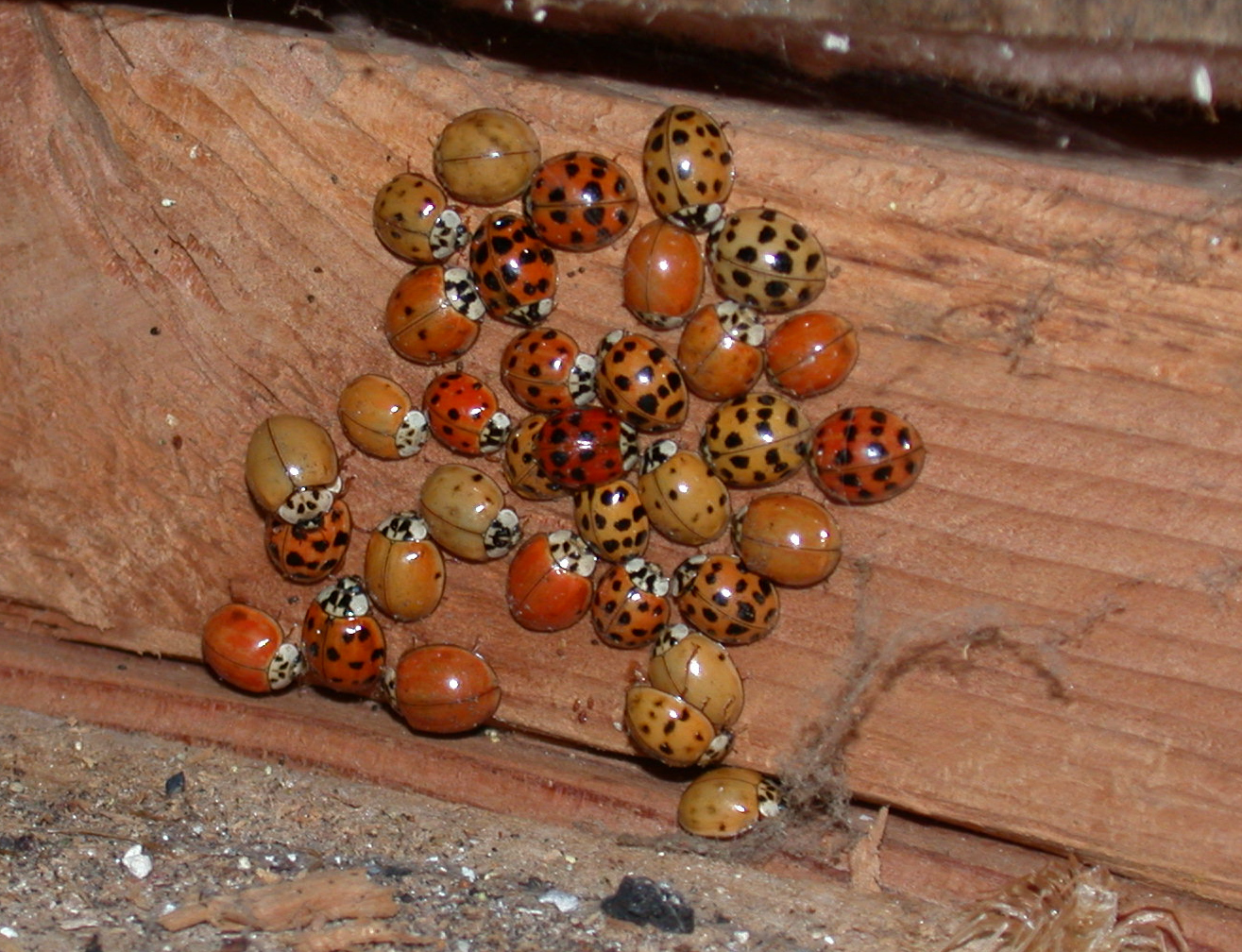
Photo credit, John Obermeyer
Asian lady beetles (ALBs), also known as multicolored Asian lady beetles or harlequin ladybirds, were introduced to the United States several times during the 20th century as biological control agents. Many of these intentional releases were unsuccessful. The first established U.S. population was discovered in Louisiana in 1988 (Ducatti et al. 2017; Chapin and Brou 1991), although it is unclear whether this population resulted from an intentional release or an accidental introduction through international trade. Since then, ALBs have spread throughout the continental United States.
The interest in introducing these beetles was driven by their potential to control aphids and other agricultural pests. If you garden or work with plants, you probably already know how effective ALBs can be at controlling aphids, scale insects, and whiteflies. Both adults and larvae are voracious predators of soft-bodied insects, making them valuable allies in gardens, landscapes, and agricultural fields. In fact, finding ALBs in your garden is often considered a good sign!
I typically hear them referred to as “beneficial” when they’re chowing down on aphids. When they’re swarming our houses in the fall, however, I more often hear them called “invasive.” There’s actually some truth to both descriptions. While they provide valuable pest control, ALBs are also an introduced species that can compete with native lady beetles and have contributed to declines in some native populations (Roy et al. 2016).
Thankfully, when it comes to our homes, ALBs don’t cause structural damage, reproduce indoors, or infest stored food. They’re primarily a nuisance. So why do they show up in such large numbers every fall?
Like many insects, ALBs need a protected place to survive the winter. In their native range of eastern Asia, they naturally congregate in large numbers in protected locations, such as rocky cliffs and crevices. Here in the Midwest, our houses make a pretty good substitute. As temperatures begin to drop, usually around mid-October, adult beetles start looking for sheltered overwintering sites. Their activity is often triggered by a cold snap followed by warmer, sunny weather. They’re particularly attracted to light-colored buildings and sunny south- and southwest-facing walls. Once they land, they crawl into cracks and crevices around windows, doors, siding, and rooflines. Some eventually find their way into wall voids, attics, and other protected spaces.
The beetles enter a dormant state called diapause, during which their activity and metabolism slow down. They remain sheltered through the winter, but on warmer days, some become active and find their way into our living spaces. This is why you might continue finding them throughout the winter and again in early spring. Don’t worry, they’re not multiplying inside your walls!
So, what can you do about them? Here are a few recommendations from Purdue Extension (Gibb 2017):
- Seal cracks and crevices. Prevention is your best defense. Seal openings around windows, doors, siding, and other potential entry points before beetles begin congregating in the fall. I can personally attest that this makes a difference! We recently sealed up all of our first-story windows, and we’ve noticed a major decrease in the number of beetles making their way indoors.
- Vacuum them up. If beetles have already made it inside, vacuuming is one of the easiest ways to remove them. Just be prepared to do this repeatedly throughout the fall and spring. One word of caution: avoid crushing them. When disturbed or crushed, ALBs release a yellowish defensive fluid that has an unpleasant odor and can stain walls, fabrics, and other surfaces. Be sure to empty your vacuum promptly, too!
- Consider pesticide treatments. Perimeter insecticide treatments can provide some relief when applied to exterior surfaces before beetles begin congregating and entering the home. Indoor sprays can kill exposed beetles, but they won’t reach those tucked away inside wall voids and other inaccessible spaces. Always use products labeled for the intended application site and follow the label directions.
The good news is that the beetles won’t be around forever (at least not in your living room!). With a little prevention and some patience, you can make your home a less attractive winter destination for these otherwise helpful predators.
Citations
Chapin, J.B. & Brou, V.A. 1991. Harmonia axyridis, the third species of the genus to be found in the United States. Proc. Entomol. Soc. Wash. 93: 630–635.
Ducatti, R.D.B., Ugine, T.A. & Losey, J. 2017. Interactions of Harmonia axyridis and the North American native lady beetle Coccinella novemnotata. Environ. Entomol. 46(1): 21–29.
Gibb, T. 2017. Asian lady beetles. Purdue Extension Publication E-273-W. Purdue University, West Lafayette, IN.
Roy, H.E. et al. 2016. The harlequin ladybird, Harmonia axyridis: global perspectives on invasion history and ecology. Biol. Invasions 18(4): 997–1044.