Do your maple leaves look like Target® is running product placement ads in unusual places? If so, you may be seeing Cristulariella leaf spot, also known as zonate leaf spot or bull’s-eye leaf spot. These dramatic target shaped leaf spots are caused by a group of fungi in the genera Cristulariella and Grovesinia. The disease is more common in the eastern states, but shows up sporadically in the Midwest in years with prolonged rainfall and high humidity.
Over 40 genera of woody plants have been reported to be susceptible to this disease, but we see the spots most commonly on maple trees. Symptoms can range from very small pinpoint lesions to very large zonate spots that cover most of the leaf (Figure 1).
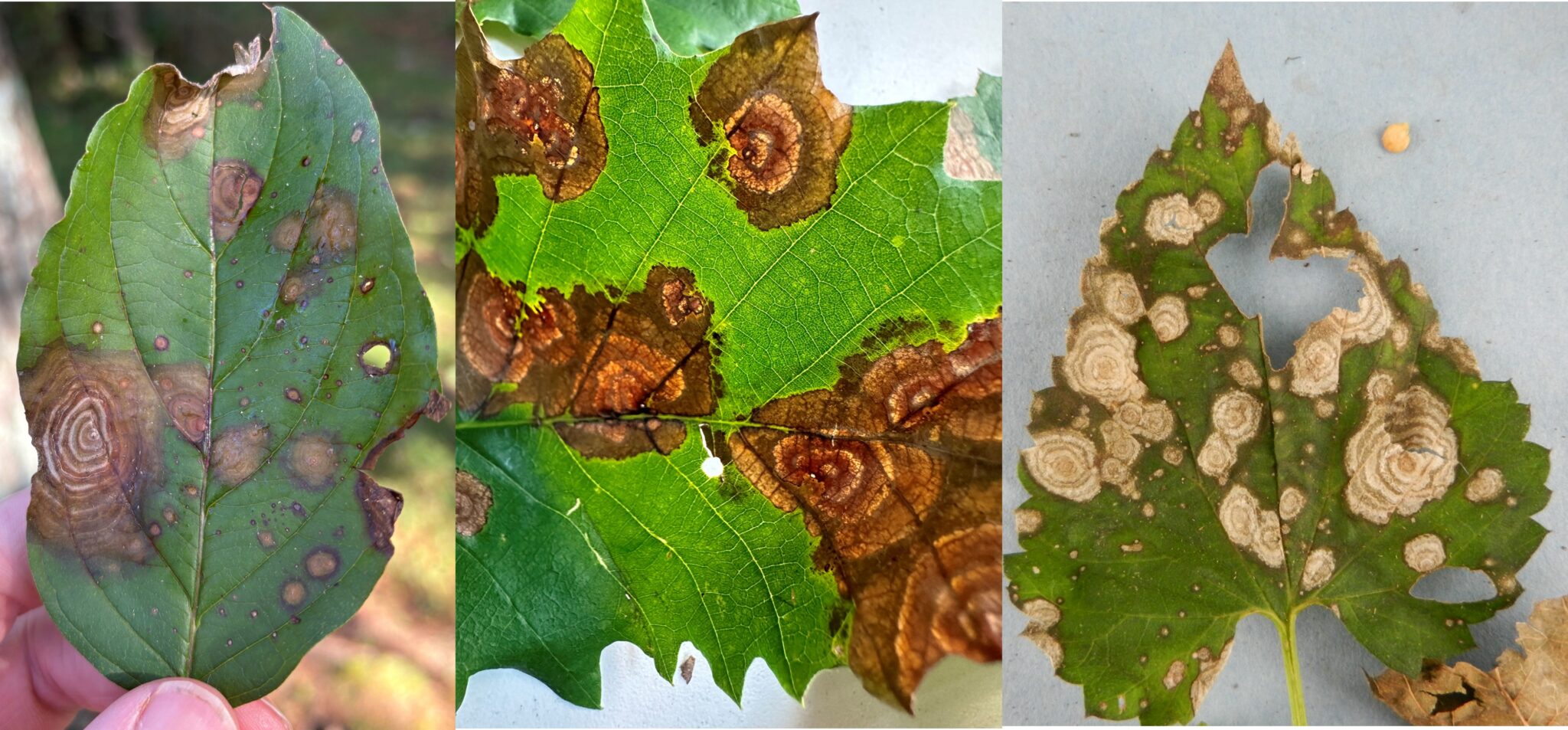
Figure 1:
Photo Credit: Left: Will Drews, Indiana Department of Natural Resources; Center and Left: PPDL
Caption: Symptoms of zonate leaf spot. Left: Dogwood, Center: Chinquapin Oak (unconfirmed), Right: Hops.
The target-like appearance develops as the fungus infects the leaf and kills tissues by the production of toxins (oxalic acid) and enzymes (pectolytic activity), which degrade the leaf tissue allowing further colonization in zones when conditions are favorable. Individual lesions may span more than 30-40% of the leaf surface, but when multiple spots develop, they can coalesce and kill the entire leaf. Over time, the affected tissue may wear down and eventually fall out, leaving holes in the leaves.
Cristulariella will sporulate on the leaf undersides when the relative humidity is over 94%, but when the humidity drops below this point, lesions will stop expanding and the fungus will not sporulate. This further reinforces the fact that we only see this disease in wet weather.
The fungus spreads by conidia which are produced on long stalks in a shape similar to a tapering brush or a Christmas tree (Figure 2, 3). On some hosts, like maples, Cristulariella may produce a forest of little white Christmas trees; however, some hosts may seldom produce spores at all, making confirmation in the field somewhat difficult. These spores, or conidia, are spread by water splash dissemination and can infect leaves at temperatures ranging from 43 to 80 degrees F. Over time, the fungus may produce sclerotia (an overwintering structure) in affected leaf tissue, typically located near leaf veins.
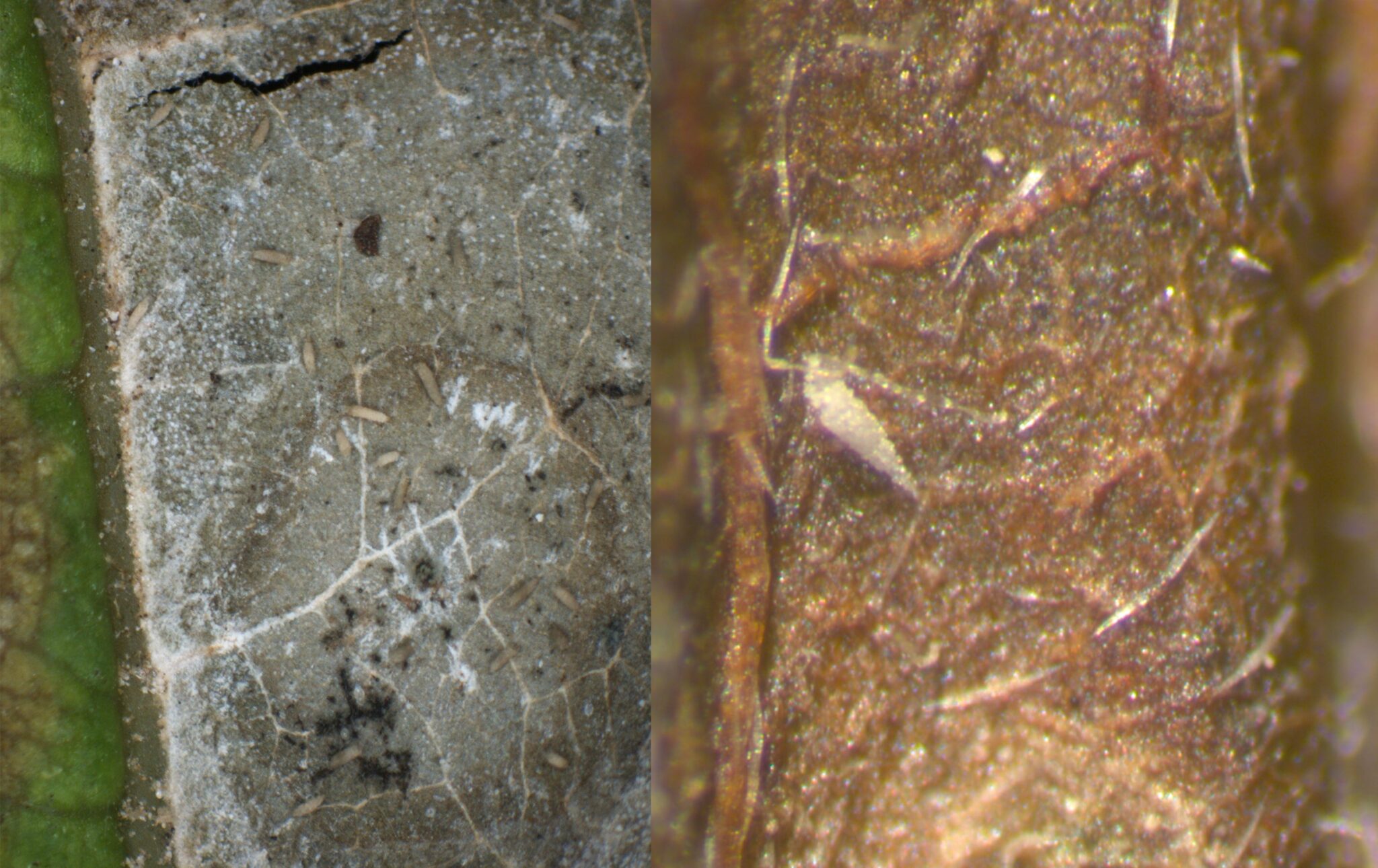
Figure 2:
Photo Credit: PPDL
Caption: Cristulariella produces this brush or Christmas tree-like structure on the undersides of symptomatic leaf tissue in cool, wet weather. Observed using a dissecting scope.
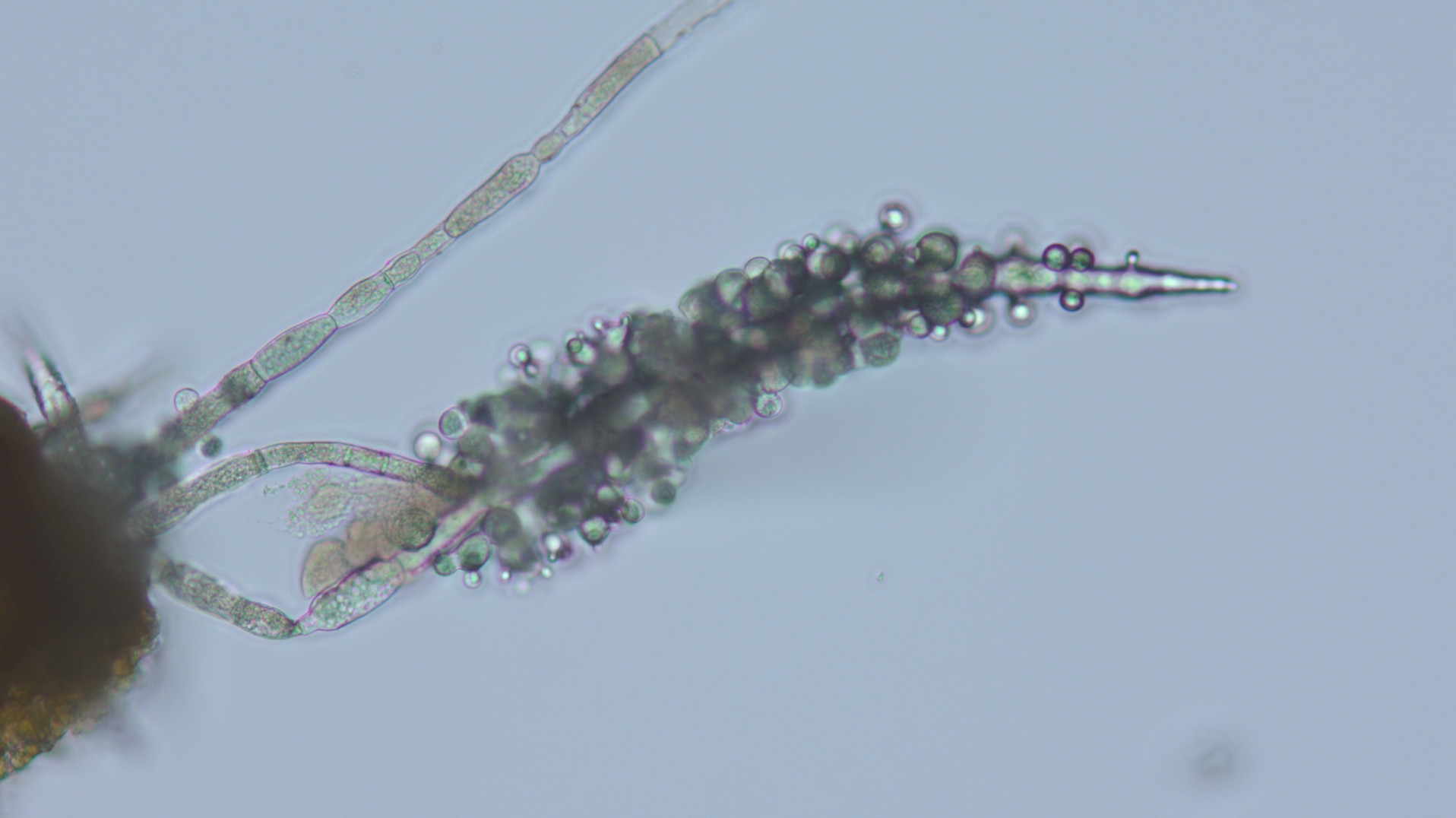
Figure 3:
Photo Credit: PPDL
Caption: Microscopic image of Cristulariella conidia produced on the brush-like structure. Observed using a compound microscope.
The disease can develop early in the growing season, but may go unnoticed until late summer since disease progression and sporulation are so sensitive to the whims of mother nature, but when there is a cool, wet season, it can cause some to major defoliation in susceptible plants. In the Midwest, management is not really necessary given the infrequent occurrence of high disease pressure. However, if you do notice high severity and premature leaf drop, please see the PLR article “Foliar Fungal Disease Management,” by Dr. Janna Beckerman: Foliar Fungal Disease Management
Due to its rarity and the distinct and interesting symptoms, this disease is often a bucket-list item for plant pathologists and diagnosticians.
Selected References:
Sinclair and Lyon, Diseases of Trees and Shrubs, 2nd Edition, 2005. Cornell University Press.