Home lawns are often vilified as detriments to the environment. In reality, however, these greenspaces provide many environmental benefits including carbon sequestration, runoff and erosion reduction, groundwater recharge, heat dissipation, soil reclamation and habitat for macro and microorganisms… when managed responsibly.
Nearly all of the home lawns in Indiana are comprised of cool season turfgrasses, meaning they grow poorly during the summer, but best in the spring and fall when temperatures are moderate but above freezing. Cool season turfgrasses, such as tall fescue and Kentucky bluegrass, are therefore most apt to utilize nitrogen fertilizer best during these moderate temperatures for growth and development.
Fall (now) is the best time to fertilize home lawns for several reasons. First off, the heat stress and disease potential of summer is in our rear-view mirror as opposed to our windshield. Fall is the perfect time for recovery from this stress with two important added bonuses over spring. Daylength or photoperiod gets shorter, so the potential for an excessive flush in leaf growth from fertilization is minimized. These flushes are more common with spring and summer fertilization and require more frequent mowing to avoid clumping of clippings. Second, fall fertilization is more primed towards root growth and carbohydrate storage for winter survival and an improved lawn the following spring. For these reasons, most of lawn fertilization efforts should be focused in the fall.
The recommendation for newer lawns is an application of 1 lb of nitrogen (N)/1000 square feet in September and another in October. Older lawns may require less nitrogen since their accumulated organic matter and established microbiome create a natural cycle for breaking down nutrients into a plant-available form. Notice, phosphorus and potassium aren’t mentioned. Both may be provided in suitable amounts by the soil already and should be gauged with a soil test before needlessly applying additional. Phosphorus, in particular, has been shown to contribute to pollution of our waterways by promoting eutrophication, which causes excessive plant and algae growth that crowds out and suffocates fish and other wildlife.
When placed on the lawn, research consistently demonstrates that a turfgrass system with its numerous, fibrous roots efficiently uses fertilizer and doesn’t allow leaching or runoff. Our urban environment, however, with its roads, driveways and sidewalks are a concrete conduit to drains that flow into our Indiana surface waters. When fertilizer granules land off-target on these hardscapes, they inevitably ride the wave and cause pollution of our ponds, lakes, rivers and streams.
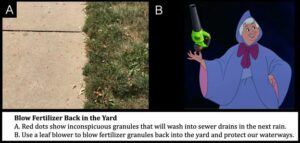
The solution is to BIBITY, or Blow it Back in the Yard. Every time a lawn spreader is used, the immediate next act should be to walk the impervious surfaces around your lawn margins and blow fertilizer or other materials back into the yard. Fertilizer granules are inconspicuous and even when carefully applied, they inadvertently land in unintended places. Do our Indiana surface waters, environment and wildlife a favor, and like Cinderella’s fairy godmother wave your leaf blower like a magic wand to BIBITY, bobbidi boo your fertilizer application back to its rightful place back onto your lawn.