We are often the bearers of bad news when a new exotic insect species is discovered in Indiana. This time, however, we have some good news to share. Agrilus smaragdifrons, a beetle that feeds exclusively on Tree-of-Heaven (Ailanthus altissima), was detected in Indiana last year in Allen County.
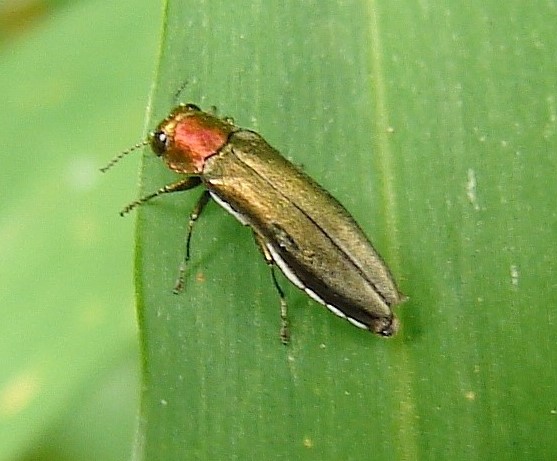
You might notice that this beetle belongs to the same genus as the infamous Emerald Ash Borer (Agrilus planipennis) (EAB). Indeed, the two species look quite similar, although there are subtle differences in their striking metallic coloration. While Emerald Ash Borer is a vibrant green from head to wing, A. smaragdifrons has a golden-red head and thorax with green to black-green wings (Fig. 1; Photograph by Dave Eib, iNaturalist; CC-BY-NC License).
This beetle has been present in the United States for several years, with the earliest record dating back to 2011 from a photograph taken in New Jersey that was uploaded to BugGuide.net. Subsequent detections occurred in several neighboring eastern states, often as bycatch during Emerald Ash Borer surveys (Hoebeke et al. 2017).
-
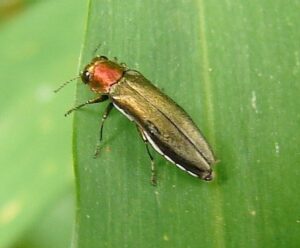
- Figure 1. Agrilus smaragdifrons adult. Photograph by Dave Eib.
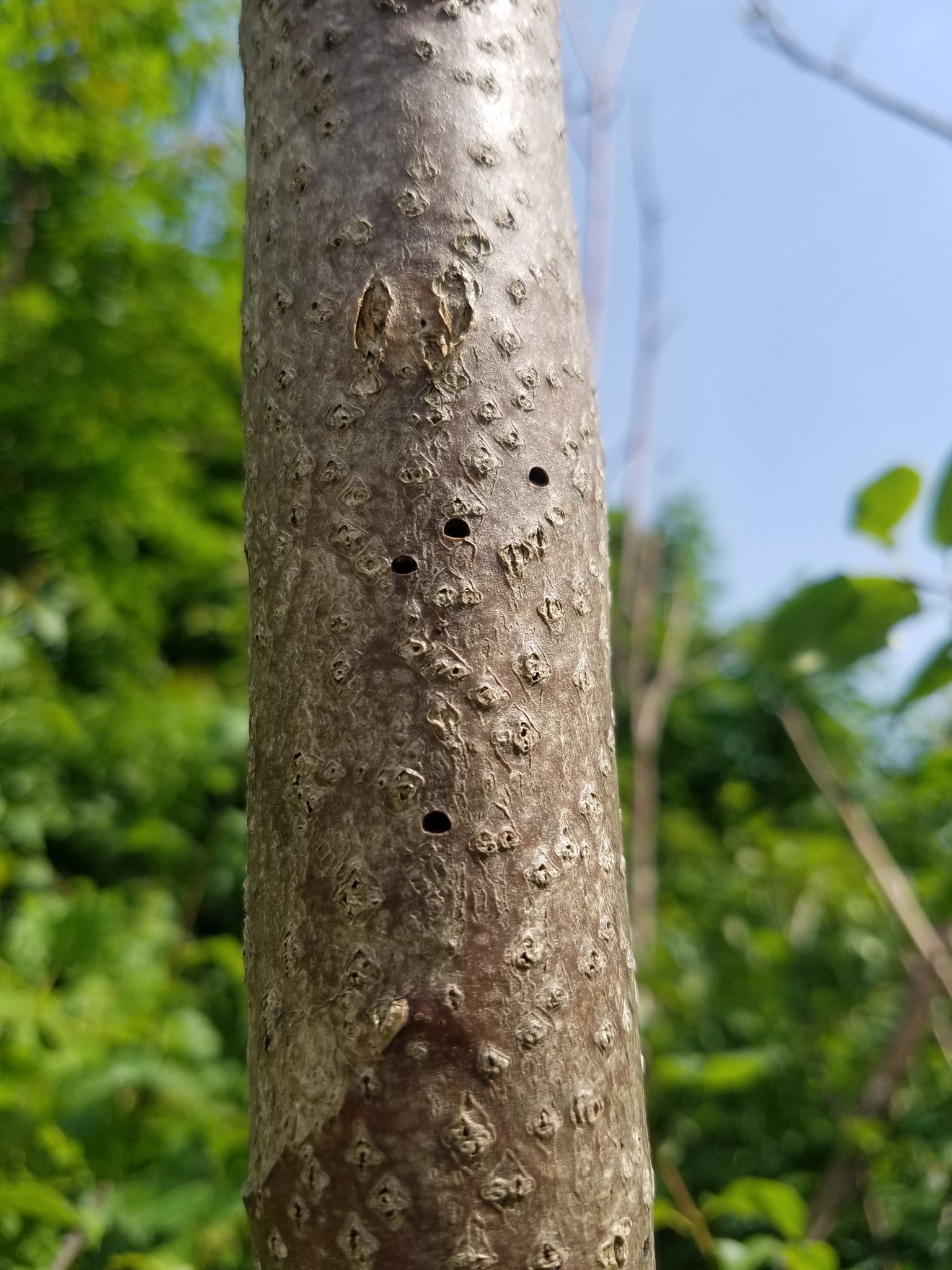
The life cycle of A. smaragdifrons also shares many similarities with Emerald Ash Borer. Although its life cycle under North American conditions has not yet been formally described, Hoebeke et al. (2017) summarize the beetle’s biology in its native Asian range based on Chinese literature (Xu and Yang 2007). Females lay eggs in bark crevices during mid- to late summer, and newly hatched larvae burrow into the tree. The larvae overwinter within galleries beneath the bark and resume feeding the following spring. Pupation occurs in early summer, around June, and adult mating flights take place from June through July. When adults emerge, they leave characteristic “D”-shaped exit holes in the bark (Fig. 2; Photograph by Patrick Perish, iNaturalist; CC-BY-NC License).
-
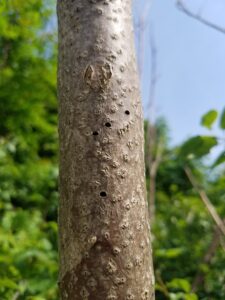
- Figure 2. Agrilus smaragdifrons exit holes in Ailanthus altissima. Photograph by Patrick Perish.
It is not yet known whether A. smaragdifrons will function as a biological control agent for Tree-of-Heaven. Additional research and field observations are needed to determine its impact on its host. However, reports from Beijing Forestry University indicate that attacks by A. smaragdifrons can lead to decline and eventual death of Tree-of-Heaven (Hoebeke et al. 2017).
Scientists with the Indiana Department of Natural Resources and Purdue University are interested in tracking the distribution of A. smaragdifrons across the state. The next time you encounter a Tree-of-Heaven, keep an eye out for the distinctive D-shaped exit holes. In late summer, you may also observe adults feeding on the leaves.
See something? Report it just as you would any other invasive species!
References:
Hoebeke et al. 2017. First North American Records of the East-Asian Metallic Wood-Boring Beetle Agrilus smaragdifrons Ganglbauer (Coleoptera: Buprestidae: Agrilinae), a Specialist on Tree of Heaven (Ailanthus altissima, Simaroubaceae). Proceedings of the Entomological Society of Washington, 119(3): 408-422. doi.org/10.4289/0013-8797.119.3.408
Xu G. T. and Z. H. Yang. 2007. “Agrilus sp.”, p. 316–317. In: Pests of Ornamental Plants in China. Beijing: China Forestry Publishing House Press. [in Chinese]